
Most stutter cases clear up with four moves: cap your frame rate two or three frames below your monitor's refresh rate, close overlays and background apps like Discord, update or clean-install your GPU driver, and move the game to an SSD if it's still on a hard drive. Pair the cap with a variable-refresh display if you have one. If those four don't fix it, the problem is deeper than a setting, and you need frame-time diagnostics to find it.
TL;DR:
- Most game stutter cases are resolved by limiting the frame rate slightly below the monitor's refresh rate and disabling overlays or background apps.
- Stutter is caused by frame-time spikes, which can be identified using free tools like MSI Afterburner or PresentMon; measuring consistent scene playback helps isolate issues.
- Updating or rolling back GPU drivers, setting shader cache to unlimited, and testing exclusive fullscreen mode often fix common frame-time inconsistencies.
- Windows 11 features like hardware-accelerated GPU scheduling, memory integrity, and certain overlay options can introduce micro-stutter that requires toggling and testing.
- Persistent stutter may require advanced diagnosis with latency monitoring, driver reinstallation, or, as a last resort, a clean Windows reinstall to eliminate system conflicts.
Table of Contents
- How to Confirm You Have Stutter, Not Just Low FPS
- Quick Fixes That Solve Most Stutter Cases
- Windows 11 Settings That Quietly Cause Micro-Stutter
- Hardware, Storage, and Thermal Checks
- Running a Reproducible Diagnostic Trace
- A Verification Checklist Worth Following Every Time
- When a Windows Reinstall Actually Makes Sense
- Let Tempered Handle the Testing Loop for You
- Sources
- FAQ
How to Confirm You Have Stutter, Not Just Low FPS
Average FPS lies to you. A game running many frames per second on average can still feel awful if some frames take significantly longer to render than others. That's stutter: a frame-time problem, not a frame-rate problem.
You don't need expensive gear to measure this. Two free tools cover almost every case:
- MSI Afterburner with the RivaTuner Statistics Server overlay shows live frame time and 1% lows on screen while you play, so you can watch the graph spike in real time.
- PresentMon captures a raw frame-time log you can review afterward, which is more precise when you need to correlate a spike with CPU, GPU, or disk activity.
Run a short, repeatable test before you touch anything: pick one scene (a specific area, a benchmark run, a loading transition) you can reproduce exactly, record two or three minutes as a baseline, then change one variable and record again. WhySoGeek's frame-time guide recommends this same one-variable approach because changing two things at once tells you nothing about which one actually helped. Now you know what you're fixing.
Quick Fixes That Solve Most Stutter Cases
Start here before touching anything more invasive. These common changes fix the majority of stutter complaints and typically take a short amount of time.
- Cap your frame rate slightly below your monitor's refresh rate. Use RTSS or your GPU driver's built-in frame rate limiter and set the cap just under your display's refresh rate (for example, slightly below 144Hz). This keeps your GPU from bouncing between fully loaded and idle, which is one of the most common causes of perceived stutter even at high average FPS. Pair the cap with a variable-refresh display when you have one.
- Kill your overlays and background companion software. Discord's overlay, Xbox Game Bar, the GeForce Experience or AMD Adrenalin overlay, and any RGB lighting software all hook into the game's rendering pipeline and can introduce frame-time spikes. Disable them one at a time and re-test.
- Update your GPU driver, and if the newest one behaves worse, roll back one version. A clean install (using the manufacturer's cleanup utility, not just "update over the top") clears out leftover driver files that sometimes cause conflicts after a Windows update.
- Set shader cache to Unlimited in your driver control panel, and resist the urge to clear it repeatedly. Shader compilation stutter happens when the game has to compile shaders on the fly the first time it sees a new effect; clearing the cache forces that to happen again.
- Test exclusive fullscreen against borderless windowed. Borderless is convenient but adds a compositing step that can cost you frame-time consistency; fullscreen mode often measurably smooths things out.
Pro Tip: Don't clear your shader cache "just to be safe" every time you update a driver. You'll trigger a fresh round of compilation stutter on your next few play sessions for no real benefit.
Windows 11 Settings That Quietly Cause Micro-Stutter
Windows 11 ships with several features aimed at convenience or security that trade off frame-time consistency, and most players never know they're on.
- Optimizations for windowed games, found under a game's Properties in Windows Settings, changes how the compositor handles that specific title. Toggle it and test both exclusive fullscreen and windowed modes to see which behaves better on your system.
- Hardware-accelerated GPU scheduling (HAGS) shifts scheduling work from the CPU to the GPU. It helps on some systems and hurts on others, so it's worth toggling and testing both states.
- Memory integrity (part of virtualization-based security) and the Virtual Machine Platform can add measurable overhead to frame latency. Microsoft's own troubleshooting threads note this as a real trade-off between security and smoothness. If you disable it for testing, understand you're giving up a real security layer, and re-enable it once you're done unless you have a specific reason not to.
- Multi-Plane Overlay (MPO) can be disabled through a registry tweak; verify the change stuck by checking DirectX diagnostics (
dxdiag) afterward. - Power plan and CPU core parking: set Windows to Best Performance or High Performance and confirm core parking is disabled, especially on newer AMD chips with mixed core types where the wrong cores getting parked mid-game causes exactly the kind of thread-scheduling hiccup that shows up as a stutter.
Hardware, Storage, and Thermal Checks
If Windows settings and drivers check out clean, look at the physical layer. Storage and heat cause a specific flavor of stutter: brief pauses tied to loading new areas or textures, rather than constant micro-jitter.
- Move the game to an SSD if it's still sitting on a hard drive. Fragmented storage forces the system to prioritize stability over frame pacing, and HDD streaming stutters show up as regular pauses whenever the game loads new assets.
- Check your CPU and GPU temperatures under a repeatable load and watch for thermal throttling: if clocks drop noticeably as temps climb, your cooling is the bottleneck, not your settings.
- Enable XMP or EXPO for your RAM, but verify stability afterward. EXPO in particular can cause erratic instability on some board and CPU combinations; if you see new crashes or odd CPU spikes after enabling it, dial the profile back a step.
- Watch VRAM usage during gameplay and lower texture quality if you're consistently maxing it out, since VRAM pressure causes its own texture-streaming stutter that looks a lot like a storage problem.
Running a Reproducible Diagnostic Trace
When the quick fixes don't move the needle, you need evidence, not more guessing. This workflow takes about twenty minutes and tells you exactly where to look next.
- Run LatencyMon for 10 to 15 minutes while idle or during light gaming. Check the top DPC (deferred procedure call) offenders in the report. Network drivers, audio drivers, and storage drivers show up most often as the culprits behind latency spikes.
- Capture a PresentMon trace during your reproducible test scene and log CPU, GPU, and disk activity in MSI Afterburner at the same time. Line up the timestamps: correlating frame-time spikes with sensor data tells you whether you're looking at shader compilation, asset streaming, a single-thread CPU bottleneck, or a driver conflict.
- Act on what the trace shows. If chipset drivers or platform-specific components (like AMD's 3D V-Cache optimizer driver) are implicated, reinstall them directly from the manufacturer rather than through Windows Update.
- Escalate only when everything above comes back clean. If stutter persists system-wide after clean drivers, clean chipset installs, and a confirmed-stable RAM profile, it's time to consider an in-place repair or clean install of Windows.
Pro Tip: Save your first PresentMon trace as a permanent baseline file. Every time you change a driver or setting afterward, you're comparing against real data instead of your memory of "it felt better before."
A Verification Checklist Worth Following Every Time
Skipping the re-capture step is how people end up with five "fixes" stacked on top of each other, unsure which one actually mattered, if any.

Some performance optimization tools scan live hardware metrics and identify system constraints, explaining proposed changes and allowing easy reversion. This approach supports reproducible testing without manual measurements.
When a Windows Reinstall Actually Makes Sense
Reinstalling should be your last resort, not your second step. Try clean driver installs, chipset updates, and PresentMon traces on a minimal Windows setup first. An in-place repair fixes corrupted system files while keeping your programs; a clean install wipes everything. If stutter survives both, testing a rollback to Windows 10 can isolate whether Windows 11 itself is the variable.
— Ian
Let Tempered Handle the Testing Loop for You
Optimization tools can automate performance diagnostics, scanning live CPU, RAM, GPU, disk, and uptime data, explaining constraints in plain language and detailing expected effects of changes before approval.
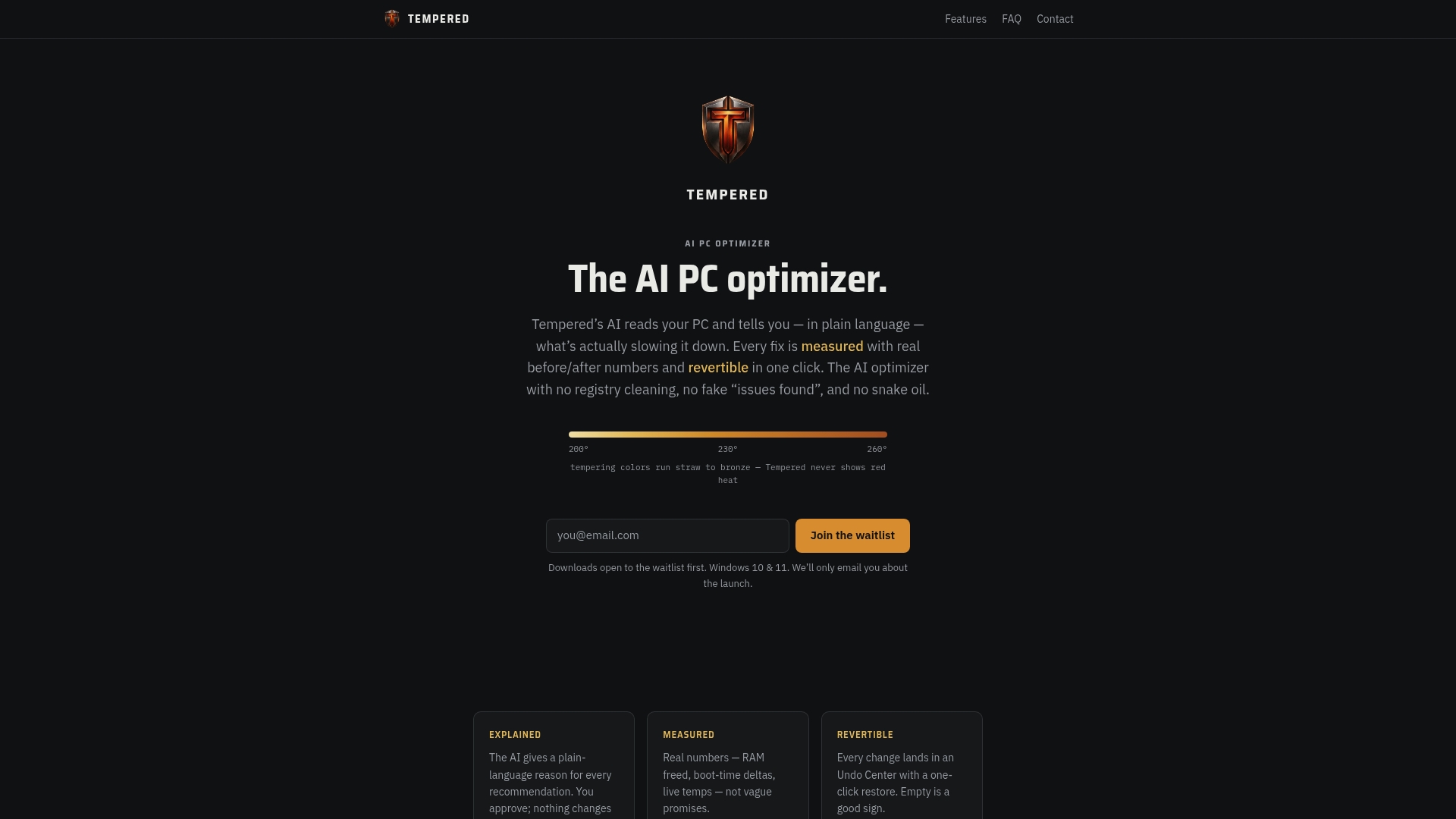
This becomes especially useful after manual fixes fail, providing continuous system monitoring to detect regressions or CPU core parking early. Changes made include easy undo options and consider anti-cheat safety for competitive gaming. Start on the free tier to see what it finds on your system, or move straight to Torque or Torque Max for unlimited scans and the full set of premium tweaks. Head to Tempered's product page to see the full diagnostic in action.
Sources
- Fix PC game stutter at high FPS: Frame time guide 2026 — WhySoGeek
- What causes game stuttering — Virgin Media
- High FPS but game stutters? Frame time and 1% lows — PC Workman
FAQ
Does 100% CPU usage cause stuttering?
Check Task Manager's per-core view during a stutter event. If one core spikes while others stay low, you're likely looking at a thread-scheduling or background-process problem rather than a raw power shortfall.
Is game stuttering a RAM issue?
It can be, particularly if your XMP or EXPO memory profile is unstable rather than genuinely broken hardware. Memory training instability from an aggressive EXPO profile can produce erratic performance that looks like a CPU or storage issue until you test with the profile dialed back.
Why am I experiencing game stuttering even with high FPS?
Cap your frame rate a few frames below your monitor's refresh rate and check your 1% lows with a PresentMon trace to confirm whether specific frames are taking far longer than the average suggests.
Why do games suddenly start stuttering after running fine?
A recent Windows update, driver update, or new background app is the most common trigger. Microsoft's own support threads document cases where cumulative Windows updates introduced new stutter that cleared up only after a driver rollback or clean reinstall, so check what changed on your system right before the problem started.