
The fastest fix is per-game: right-click the executable, open Properties, go to the Compatibility tab, and check "Disable fullscreen optimizations." That single toggle handles most stutter, alt+tab, and overlay complaints without touching the registry. Save the registry method for system-wide changes, and only bother with any of this if you're actually seeing a problem. Change one thing, test it, revert if it didn't help.
TL;DR:
- Disabling fullscreen optimizations per game is quick, reversible, and best tested on the worst-performing titles before applying system-wide changes.
- Registry editing to disable fullscreen optimizations affects only the current user and requires a sign-out or restart to take effect.
- Turning off fullscreen optimizations may improve performance in some cases but can slow Alt+Tab response and affect overlay functionality.
- The feature is generally recommended by Microsoft unless users experience specific issues such as input lag, stutter, or overlay conflicts.
- Always test each change with a consistent scenario and revert if it does not deliver measurable improvements, emphasizing a measurement-based approach.
Table of Contents
- How to disable fullscreen optimizations for one game
- How to disable fullscreen optimizations system-wide
- When is disabling fullscreen optimizations actually worth trying?
- How to test the change and know if it worked
- What you might lose by turning it off
- What Microsoft actually recommends
- Why measured, reversible tweaks beat blanket settings
- A faster way to test and undo Windows tweaks
- Where to go for the official steps and deeper detail
- Sources
How to disable fullscreen optimizations for one game
This is the method Microsoft itself documents, and it's the one to try first because it's reversible in five seconds and only affects the game you're troubleshooting.
- Locate the game's executable file. For Steam titles, that's usually inside
SteamLibrary\steamapps\common\[Game Name]. Epic Games Store titles live under a similar folder structure in your chosen install directory. If you're not sure, right-click the desktop shortcut and choose "Open file location." - Right-click the
.exefile (not the shortcut, if you can help it) and select Properties. On Windows 11, the streamlined context menu sometimes hides this option, so click "Show more options" first. - Click the Compatibility tab.
- Check the box labeled "Disable fullscreen optimizations."
- Click Apply, then OK.
- If you want this to apply to every account on the PC, click "Change settings for all users" before applying, then check the same box in that secondary window.
That's the whole process, and it matches the per-exe steps Microsoft outlines in its own DirectX developer blog.
If the checkbox is grayed out, two things are usually happening: either you're not running with the permissions needed to modify that executable's settings, or the game is managed by a launcher that resets compatibility flags on update. Try right-clicking and running as administrator first. If it's still locked, skip ahead to the registry method below.
Pro Tip: Test the toggle on your worst-performing game first. If it doesn't help there, it's unlikely to matter on titles that already run fine.
How to disable fullscreen optimizations system-wide
- Press
Win + R, typeregedit, and hit Enter. - Navigate to
HKEY_CURRENT_USER\System\GameConfigStore. - Before changing anything, right-click the
GameConfigStorekey, choose Export, and save a backup file somewhere you'll remember. - Find the value named
GameDVR_FSEBehavior. Double-click it and set the data to2to disable fullscreen optimizations, or0to re-enable them. - Some systems also list
GameDVR_DSEBehaviornearby, which controls related exclusive-fullscreen behavior. Microsoft's own documentation covers both keys and their value meanings. - Sign out and back in (a full restart is safer) for the change to take effect.
Where the operating system offers one, check Settings → System → Display → Graphics for a per-app or global override, though its availability shifts between Windows builds, and some releases have dropped the toggle from the graphics panel entirely, pushing users toward the registry route instead. If you're managing multiple monitors, be aware that display configuration data can create several near-identical subkeys under GraphicsDrivers\Configuration, so double-check you're editing the one tied to your active setup.
Pro Tip: The registry setting is per-user, not per-machine. If a second Windows account still has the old behavior, you'll need to repeat the edit under that profile.
When is disabling fullscreen optimizations actually worth trying?
This isn't a setting to flip preemptively. It's a troubleshooting step, and it earns its place on your list only when something is visibly wrong.
Try it when you notice:
- Frame rate drops specifically in fullscreen or borderless mode that don't show up in windowed mode
- Noticeable input lag or stutter that syncs with mouse movement or fast camera pans
- A black screen or multi-second delay when you Alt+Tab out of the game
- Conflicts between an overlay (Discord, an Xbox Game Bar widget, a capture tool) and the game window freezing or flickering
- Older titles running at a custom resolution that look stretched, blurry, or scaled incorrectly
It usually won't help if the game already runs smoothly and your only motivation is "more FPS, just because." Modern titles with mature DirectX 12 or Vulkan support tend to handle the DWM-managed borderless window just fine, and disabling the feature there risks losing conveniences like near-instant Alt+Tab and reliable overlay rendering for no measurable gain. Community reports on forums like Reddit back this up: some users see a real improvement, others see none, and a few report the opposite.
The rule that separates a useful tweak from a waste of time: change exactly one setting, then test it before touching anything else.
How to test the change and know if it worked
Anecdote is a bad substitute for a number. Before you touch the Compatibility checkbox or the registry, take fifteen minutes to establish a baseline.
- Pick a repeatable test case: the same map, the same benchmark run, or the same busy scene you already know is demanding.
- Record average FPS and, more importantly, your 1% low FPS using an in-game counter, RivaTuner Statistics Server, or the Windows Game Bar overlay (if you're not disabling that too).
- Note anything qualitative: does Alt+Tab feel instant? Do overlays render correctly? Is there visible stutter?
- Apply the fullscreen optimizations toggle for that one game.
- Run the identical scenario for 10 to 20 minutes under similar load conditions.
- Compare the two sets of numbers side by side, and also compare what you gave up.
Uncheck the box, or set the registry value back to 0, and write down what you changed and why it didn't stick. That two-line note saves you from re-testing the same failed tweak three months from now when you've forgotten you already tried it.
Pro Tip: Test during a session that mirrors real play, not a menu screen. Fullscreen optimization issues tend to show up under GPU load, not while you're staring at a loading screen.
What you might lose by turning it off
Disabling fullscreen optimizations isn't a free upgrade. It's a trade, and it's worth knowing what's on the other side of the ledger before you commit.
- Alt+Tab can become noticeably slower, sometimes dropping to a black screen for a second or two instead of the near-instant switch the DWM-managed window normally provides
- Overlays like Xbox Game Bar captures, Discord's in-game overlay, and some third-party tools can stop rendering correctly or fail to launch at all
- Custom-resolution setups and older games occasionally behave better once the composited window is out of the picture, but scaling quirks can also appear where none existed before
Third-party testing on custom-resolution and older-game scenarios has shown measurable latency reductions and improved 1% lows in some cases, but the same source is clear that results vary by title, GPU driver, and display setup. There's no universal outcome here, which is exactly why the test-and-revert habit matters more than the toggle itself.
Keep a short running list of what you've changed and where, including a copy of any exported registry key. It costs nothing and saves real time if you need to walk a setting back six weeks later.
What Microsoft actually recommends
Microsoft built Fullscreen Optimizations to give games the performance profile of exclusive fullscreen while keeping the convenience of a windowed desktop, managed through the Desktop Window Manager. Its own developer guidance is direct: leave the feature enabled unless you're seeing a specific regression, because for most setups it's not costing you anything.
If you do hit a reproducible problem, Microsoft wants to hear about it rather than have you quietly work around it forever:
- Report the issue through the feedback link at aka.ms/fullscreenoptimizationsfeedback
- Include exact repro steps: the game, the GPU driver version, and what setting you toggled
- Attach a screen capture or video if the issue is visual (stutter, black screen, scaling)
- Note whether the registry method or the Compatibility checkbox was used, since both paths get tracked differently on Microsoft's end
Why measured, reversible tweaks beat blanket settings
Most performance advice online skips the measurement step entirely. Someone says a toggle "fixed" their stutter, and it spreads as gospel, even though the same setting does nothing for the next ten people who try it. That's the real lesson buried in the fullscreen optimizations debate: the feature itself is fine for most setups, and the fix that matters is the discipline of testing one change at a time and reverting when it doesn't pay off.
Tempered was built around that same instinct. It looks at your actual CPU, GPU, RAM, and disk activity, proposes specific changes instead of vague tune-ups, and keeps a clear undo path for every one of them. For readers digging into broader Windows 11 gaming optimization, that same measured approach applies well beyond one checkbox.
— Ian
A faster way to test and undo Windows tweaks
Manually toggling registry values, exporting backups, and remembering which setting you changed six games ago gets tedious fast. Tempered is built for exactly that kind of ongoing PC tuning: it scans your live hardware metrics, flags real constraints instead of guessing, and proposes specific changes with a one-click undo attached to each one.
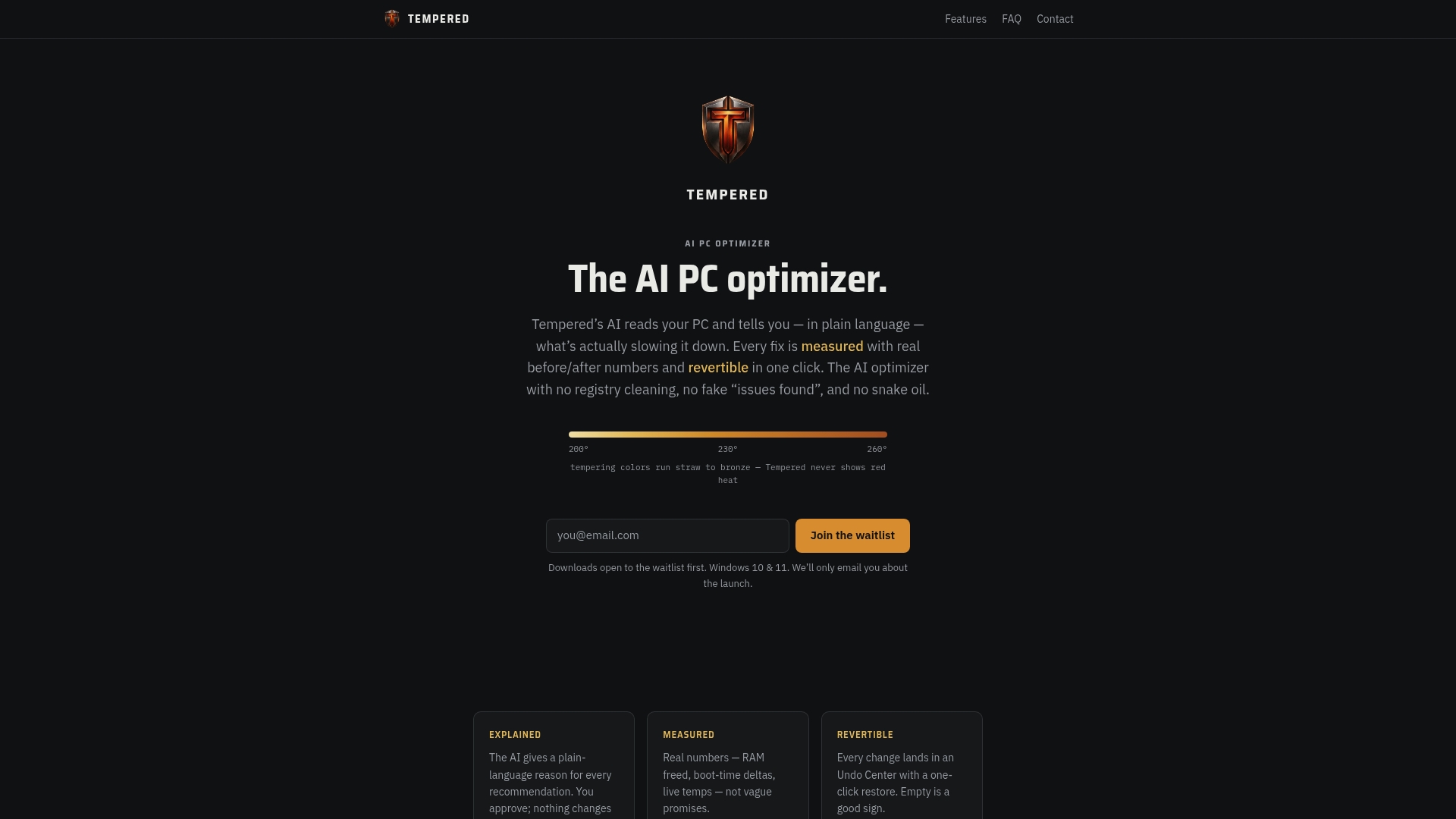
Where this guide had you manually testing fullscreen optimizations, checking Xbox Game Bar conflicts, and tracking Windows Game Mode settings by hand, Tempered centralizes that process and keeps a full history of what changed and when. You approve every tweak before it applies, and reverting takes one click instead of a registry hunt. If you want to see what's actually limiting your system beyond a single checkbox, start a scan on the Tempered product page and see what it finds on your own PC.
Where to go for the official steps and deeper detail
Microsoft's own DirectX developer blog and Microsoft Answers registry guidance are the primary sources behind every step in this guide. For screenshots of each click, Winaero's walkthrough covers both the Compatibility checkbox and the registry method in detail.
Sources
- Demystifying Fullscreen Optimizations - DirectX developer blog
- Microsoft Answers — enable or disable full screen optimizations on Win