
Windows 11 25H2 now edges out Windows 10 in most gaming benchmarks, but only after you tune it. Out of the box, a fresh Windows 11 install can actually run slower than a well worn Windows 10 setup. If your hardware meets Windows 11's requirements, upgrade and run through an optimization pass. If you play one specific competitive title where every millisecond counts, test both before you commit.
TL;DR:
- Windows 11 shows modest performance improvements over Windows 10 in gaming benchmarks, mainly after system tuning and optimization.
- Performance gains are most noticeable in CPU-limited, modern AAA titles on hybrid Intel CPUs, especially with DirectStorage and scheduler improvements.
- Default security features like Memory Integrity can reduce frame rates, so disabling them may improve gaming performance at security tradeoffs.
- Driver versions, BIOS settings, and active background processes significantly influence actual gaming performance, making individual testing essential.
- Power management in Windows 11 responds faster to load spikes, offering steadier clock speeds during long gaming sessions, especially on laptops.
Table of Contents
- Windows 10 vs 11 Gaming Performance: What the Benchmarks Actually Show
- What Windows 11 Does Well for Gamers
- Where Windows 11 Can Actually Fall Behind
- How to Read Gaming Benchmarks Without Getting Fooled
- Getting Windows 11 to Perform Like the Lab Benchmarks
- Should You Upgrade to Windows 11 for Gaming Right Now?
- Power Draw and Thermal Behavior During Long Gaming Sessions
- Does Windows 11's Game Mode Actually Help?
- Input Lag and Frame Pacing: The Difference You Actually Feel
- What Surprised Me Testing This
- Get Benchmark-Level Gains Without Guessing at Settings
- Where These Numbers Come From
- Sources
Windows 10 vs 11 Gaming Performance: What the Benchmarks Actually Show
The clearest picture comes from TechSpot's 14-game suite, which found Windows 11 25H2 runs modestly faster than Windows 10 at 1080p and shows slightly larger gains at 1440p and 4K, measured as an average across the test suite. That is not a blowout. It is the kind of gap you would not notice blind, but it adds up when a title is already leaning on every clock cycle it can get.
Averages hide the interesting part. Windows Central's hands-on testing across seven games found that mean FPS often landed within margin of error between the two operating systems, but 1% lows told a different story. In a few titles, minimum frame rates dropped noticeably after the Windows 11 upgrade, which is the kind of change a stopwatch average will never catch but your hands will feel instantly during a firefight.
Individual titles moved the needle far more than the average suggests:
- Arc Raiders showed some of the largest gains recorded on Windows 11 25H2, in the range of 11% to 15% depending on resolution.
- Borderlands 4 followed a similar pattern, landing gains around 9% to 13%.
- Spider-Man 2 showed smaller, more modest improvements, consistent with a game that leans more on GPU throughput than scheduler behavior.
- Horizon Zero Dawn Remastered produced mixed results depending on driver version, a pattern that shows up repeatedly in this generation of testing.
- Counter-Strike 2, a CPU-bound esports title, saw measurable gains tied directly to scheduling improvements rather than raw GPU horsepower.
None of this holds steady across every rig. Driver version, GPU vendor, and even BIOS settings shift these numbers, sometimes by more than the OS difference itself. Treat any single benchmark chart as a snapshot of one rig on one driver build, not a universal law.
What Windows 11 Does Well for Gamers
Windows 11's advantages concentrate around scheduling and storage, not raw horsepower. The Thread Director feature, built for Intel's hybrid CPU architecture, helps the OS route game threads to the correct core type instead of dumping heavy work onto efficiency cores meant for background tasks.
Where the gains show up:
- CPU-limited scenarios on 12th-gen Intel chips and newer, where scheduling tests have logged gains of 5% to 15%
- Games with heavy asset streaming that benefit from DirectStorage's more direct path between SSD and GPU memory, improving load times and reducing 1% low dips
- Titles patched or re-tested after the 25H2 update, which resolved several scheduler and driver interaction bugs that dragged down early Windows 11 releases
Pro Tip: If you're on an AMD Ryzen chip or an older Intel CPU without hybrid cores, don't expect the Thread Director benefit at all. That scheduling advantage is specific to Intel's mixed core design, and AMD users typically see far smaller differences between the two operating systems.
Gains show up most reliably in CPU-bound, modern AAA titles running on hybrid Intel silicon. GPU-bound scenarios at high resolution tend to erase the difference almost entirely, since the graphics card becomes the bottleneck long before the OS scheduler matters.
Where Windows 11 Can Actually Fall Behind
Windows 11 ships with security defaults that Windows 10 doesn't enforce the same way, and one of them has a real performance cost. Memory Integrity, part of Virtualization-Based Security (VBS), can reduce frame rates by a small but noticeable margin in CPU-intensive games. It's on by default on most new Windows 11 installs and OEM builds.
Common reasons Windows 10 still wins on a specific rig:
- VBS and Memory Integrity enabled by default, adding overhead most players never notice they're paying for
- Driver-version mismatches, since TechSpot's testing found that NVIDIA and AMD driver builds can flip which OS wins on the exact same hardware
- Older or unpatched games that were never validated against Windows 11's newer subsystems, occasionally causing stutter or crashes
- Multi-monitor setups reporting intermittent frame pacing issues that don't show up on single-display configurations
- TechRadar's reporting on 25H2 notes that, even as average performance improved, some patch cycles introduced stability regressions and driver conflicts significant enough to cause crashes
Pro Tip: Never judge an upgrade by average FPS alone. A five percent average gain paired with a fifteen percent drop in your minimum frame rate is a net loss for how the game actually feels.
How to Read Gaming Benchmarks Without Getting Fooled
Reproducing lab results on your own PC starts with understanding what the labs actually control for. TechSpot and Hardware Unboxed test across multiple CPU platforms, including both AMD Ryzen and Intel hybrid chips, precisely because a scheduling advantage on one platform can vanish or reverse on another.
To validate any claim on your own hardware:
- Run each game at 1080p, 1440p, and 4K, since GPU-limited 4K runs tend to mask OS-level differences almost entirely.
- Repeat each test three times and average the results, rather than trusting a single run that could be skewed by background tasks.
- Record the 1% low alongside the average FPS. It's a better indicator of how smooth the game actually feels.
- Match GPU driver versions exactly between the Windows 10 and Windows 11 test, since a driver mismatch alone can produce a bigger swing than the OS itself.
- Use a geomean across your test titles instead of a simple average, so no single outlier game distorts your conclusion.
Getting Windows 11 to Perform Like the Lab Benchmarks
Closing the gap between a stock Windows 11 install and the numbers in a benchmark chart takes a short, specific list of changes, not a full system overhaul.
Start with Memory Integrity. Turning it off in Windows Security under Device Security can recover a few percentage points in CPU-heavy games, but it does lower a real security boundary against certain kernel-level exploits. That's a tradeoff worth making consciously, not blindly.
Next, treat GPU drivers like a variable you test, not a box you check once. Update, benchmark, and if frame times get worse or you notice new stutter, roll back and document what changed. A reproducible driver-testing workflow beats guessing every time.
From there, work through the smaller settings that add up:
- Verify hardware-accelerated GPU scheduling is actually on, then benchmark before and after to confirm it helped your specific title
- Turn on Windows Game Mode and check whether it conflicts with any capture or overlay software you run
- Set your power plan to High Performance or Ultimate Performance and confirm the maximum processor state isn't throttled below 100%
- Disable Xbox Game Bar's background recording, which quietly eats CPU cycles during play
Pro Tip: Check for thermal throttling and disk bottlenecks before you touch a single software setting. A CPU hitting its thermal limit or a nearly full SSD will erase any OS-level gain you're chasing.
This is exactly the diagnostic gap a tool like Tempered is built to close: identifying which background processes are actually hogging your CPU before you start guessing at settings.
Should You Upgrade to Windows 11 for Gaming Right Now?
If your rig meets the hardware requirements and you're not tied to one ultra-sensitive competitive title, upgrade and run the optimization pass above. The scheduling and storage advantages are real, and Windows 10's free support ended in October 2025, which means future driver and engine compatibility work will target Windows 11 first.
If you're running older hardware, rely on legacy software, or compete at a level where a single stutter costs you a match, test both operating systems on your exact rig before switching.
Three-step checklist: back up your system, test your top three games on both OS versions if possible, then apply the driver and power settings above once you've picked a side.
Power Draw and Thermal Behavior During Long Gaming Sessions
Windows 11's power management runs on a more granular model than Windows 10's, built around Modern Standby and more aggressive core parking on idle threads. During short bursts, this barely registers. During a three-hour session, it can change how your CPU ramps clock speeds under sustained load, particularly on laptops.
Thermal throttling behavior differs less because of the OS itself and more because of how each OS interacts with your power plan and manufacturer firmware. A laptop with an aggressive OEM power profile will throttle similarly on either OS once it hits its thermal ceiling. Desktop rigs with adequate cooling rarely show a meaningful throttling difference tied to the OS alone.
Where Windows 11 tends to differ is in how quickly it responds to load spikes. The revised power engine in Windows 11 shifts between power states with less lag than Windows 10's older model, which can translate into steadier clock speeds during scenes with sudden CPU demand, like a firefight breaking out after quiet exploration. On sustained, GPU-bound loads, this difference mostly disappears, since the GPU's own thermal limits take over as the dominant factor.
If you're chasing consistency over a long session, check your power plan settings on both operating systems rather than assuming one OS is inherently cooler running. The plan you choose matters more than which OS is running it.

Does Windows 11's Game Mode Actually Help?
Game Mode does something narrow and specific: it deprioritizes background tasks and Windows Update activity while a game is running in focus, freeing up CPU cycles for the foreground process. On a clean system with minimal background clutter, the effect is small, often within a percent or two. On a system running Discord, a browser with a dozen tabs, and a capture tool simultaneously, Game Mode's effect becomes far more noticeable.
Game-specific optimizations layered on top of Game Mode tend to matter more than Game Mode itself. Many modern titles ship their own in-engine settings that interact with Windows scheduling, shader caching, and memory allocation, and those settings frequently make a bigger difference than any OS-level toggle. A game with poor shader precompilation will stutter on both operating systems until that engine-level issue is addressed.
The friction point worth knowing about: Game Mode occasionally conflicts with capture software or certain overlays, throttling their update rate to prioritize the game. If you stream or record, and your overlay feels laggy, that's often Game Mode working as designed rather than a bug. Confirm whether Game Mode is helping or hurting your specific setup by toggling it and running the same benchmark both ways.
Input Lag and Frame Pacing: The Difference You Actually Feel
Average FPS gets the headline, but frame delivery consistency is what your hands notice first. A game running at a lower average FPS with tight, even frame timing can feel smoother than a game with a higher average FPS but erratic delivery. This is exactly why 1% lows carry more real-world weight than the top-line average in most of the testing referenced above.

Input latency itself is influenced less by the OS choice and more by settings both operating systems share: V-Sync, frame caps, and whether you're running a variable refresh rate display. Windows 11 doesn't inherently add or remove input lag compared to Windows 10 in most testing, but its scheduling changes can produce steadier frame pacing in CPU-bound titles, which reduces the perceived stutter that makes latency feel worse than it measures.
If frame delivery consistency matters more to you than raw average FPS, particularly in fast-paced competitive titles, it's worth understanding how variable refresh rate settings interact with your OS and display before you assume an upgrade alone will fix uneven pacing. The refresh rate settings and the OS scheduler both play a role, and tuning only one while ignoring the other leaves performance on the table.
What Surprised Me Testing This
The biggest surprise wasn't that Windows 11 25H2 pulled ahead. It's how much that lead depended on things that have nothing to do with the OS build number: which GPU driver was installed, whether VBS was flipped on by default, whether a game had been patched recently. Two rigs with identical specs produced different winners depending on driver version alone.
That's the real lesson here: don't trust a headline percentage from any single test. Run your own comparison on your own hardware before you decide.
— Ian
Get Benchmark-Level Gains Without Guessing at Settings
Every optimization step covered above, disabling Memory Integrity, checking GPU scheduling, hunting down CPU hogs, testing driver versions, takes real diagnostic work to do safely. There are diagnostic tools that scan live hardware metrics, flag specific processes or settings limiting frame rate, and explain in plain language what changing them will do before approval is given.
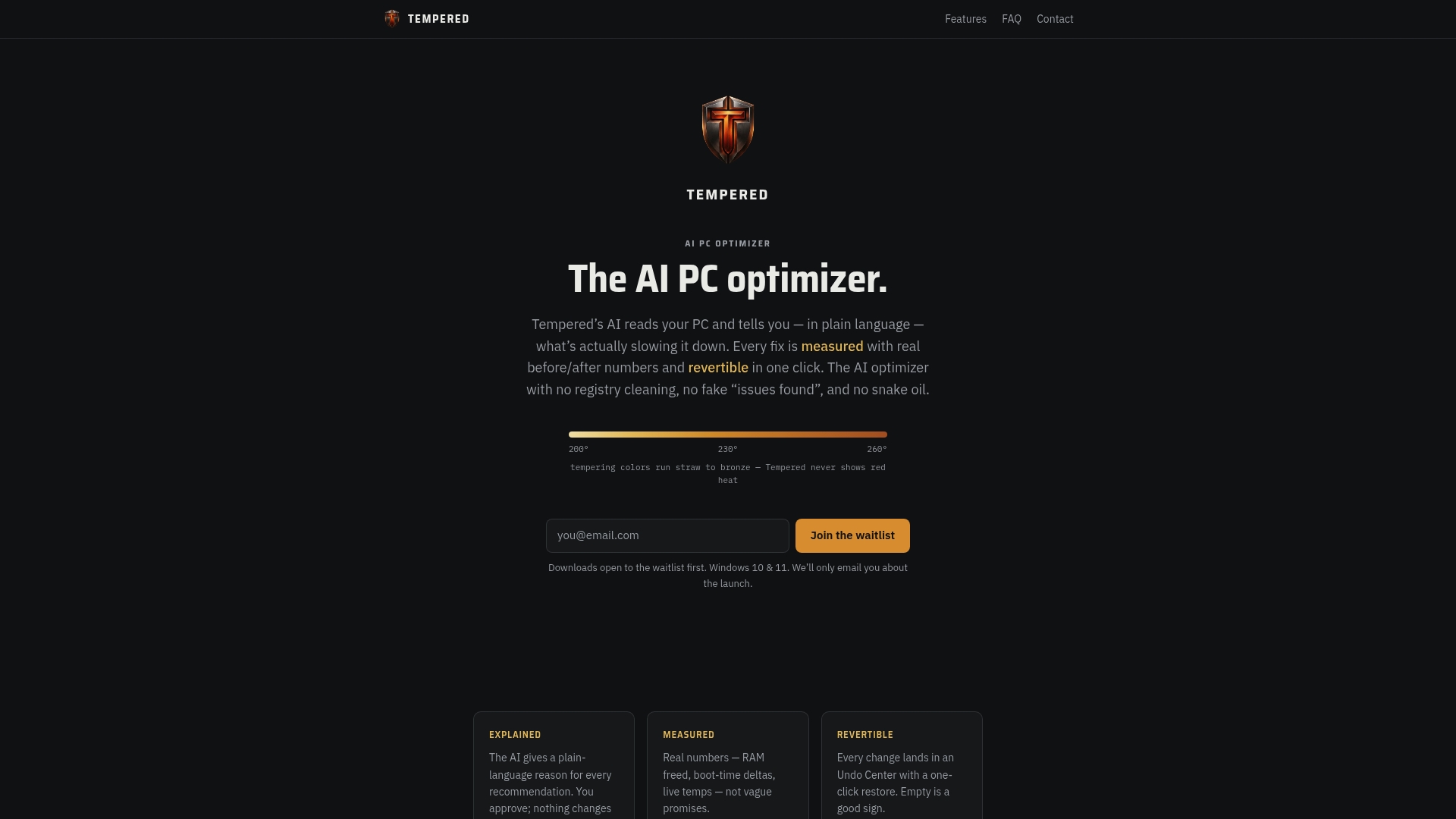
Some optimization tools offer one-click undo features, so testing changes like driver rollbacks or power plan switches does not risk leaving a system worse off than before. That maps directly onto the workflow this article recommends: identify the bottleneck, test one change at a time, keep a way back. If you want to see what's actually limiting your setup right now instead of guessing from a benchmark chart written for someone else's rig, run a free scan with Tempered and see what it finds on yours.
Where These Numbers Come From
The benchmark figures cited throughout this article come from a small set of outlets that publish full methodology alongside their results, not just headline numbers.
- TechSpot's 14-game suite breaks down per-title results across three resolutions
- Windows Central's hands-on testing highlights 1% low discrepancies often missed elsewhere
Check the full pages for game-level detail specific to your hardware.
Sources
- Windows 11 25H2 vs Windows 10: Which is Faster for Gaming? | TechSpot
- Windows 11 vs. Windows 10 for gaming: Is it worth upgrading? | Windows Central
- Windows 10 security alert — PCMag