
Keep NVIDIA shader cache enabled. It's the setting that gives you the smoothest long-term performance, and the right first move after any driver update or fresh install is patience, not deletion. Launch your game a few times and let the cache rebuild. Only clear it if stutter or visual glitches stick around after that.
TL;DR:
- After a driver update or fresh install, temporary hitching can last several sessions; launch each affected game three to five times before diagnosing cache failure.
- For suspected corruption, disable shader cache in the NVIDIA App, reboot, clear DXCache, GLCache, and NV_Cache contents, restore the default setting, and reboot again.
- If stutter persists after rebuilding, update or roll back the driver, verify game files, close overlays and scans, and check frame times before blaming the cache.
- Linux players using Proton compatibility layers may hit the cache size cap; environment variable workarounds are advanced and do not apply to NVIDIA’s Windows procedure.
Table of Contents
- What NVIDIA shader cache does for your games
- Where NVIDIA stores shader cache files on Windows
- How to clear NVIDIA shader cache safely
- Troubleshooting stutter that won't go away
- Advanced notes on cache-size limits and environment variables
- A measured approach beats a destructive one
- Optional: run a reversible scan before you touch any cache
- FAQ
- Sources
What NVIDIA shader cache does for your games
Shader cache is a folder of precompiled shader binaries that the driver saves to disk so your GPU doesn't have to recompile the same shader code every time you load a scene. Without it, every shader your game needs gets compiled fresh on the spot, which is exactly the kind of work that causes those brief freezes when you walk into a new area or a new enemy appears on screen.

With the cache warm, the driver pulls a ready-made binary instead of rebuilding it, which cuts CPU and GPU spikes and shortens the stalls you'd otherwise feel as hitching. That's why disabling shader cache almost always makes things worse: you lose the stored work and the driver has to recompile constantly.
The catch is that a driver update or a fresh install invalidates part or all of that saved work. The driver has to rebuild the cache from scratch, so you'll likely feel some stutter for the first several play sessions after any update.
- Shader cache stores precompiled binaries so the GPU skips redundant recompilation.
- Driver updates and clean installs force a rebuild, which is the usual source of post-update stutter.
- The stutter is typically temporary and fades as the cache repopulates.
Pro Tip: Give a game at least three to five full launches after a driver update before assuming anything is actually broken.
Where NVIDIA stores shader cache files on Windows
NVIDIA splits shader cache across a few folders depending on the graphics API your game uses. Knowing the exact paths lets you check their size or clear them safely instead of guessing.
- Press Win+R, type
%USERPROFILE%\AppData\Local\NVIDIA\DXCache, and hit Enter to open the DirectX shader cache. - Open
%USERPROFILE%\AppData\Local\NVIDIA\GLCachethe same way for OpenGL titles. - Open
%USERPROFILE%\AppData\Local\NVIDIA Corporation\NV_Cachefor the Vulkan and general driver cache. - In File Explorer, enable "Show hidden files" under the View tab if any of these folders don't appear.
- Right click each folder and check Properties to see how large the cache has grown over time.
Delete only the files inside these folders, never the DXCache, GLCache, or NV_Cache folders themselves. The driver expects those directories to exist, and removing them can cause permission errors or force an awkward recreation the next time you launch a game.
How to clear NVIDIA shader cache safely
Deleting NVIDIA Shader Cache files is NVIDIA's own documented fix for corruption, crashes, or artifacts tied to a damaged cache, and it's worth following exactly as written rather than improvising.
- Open the NVIDIA App and disable the shader cache option, then reboot your PC.
- Clear the contents of DXCache, GLCache, and NV_Cache using the paths above.
- Reopen the NVIDIA App, re-enable shader cache at the driver default size, and reboot again.
That official workflow handles most cases. If stutter or corruption survives it, Display Driver Uninstaller's "Clean Shader Cache (Only)" option targets the same folders through a dedicated clean pass, which some users find catches leftovers that manual deletion misses. Run DDU in Safe Mode, close every game and background NVIDIA process first, and avoid running a full driver wipe unless you're also planning to reinstall drivers afterward.
Advanced users sometimes reach for a community PowerShell script that removes .nvph files from DXCache directly. It needs to run as administrator with games and NVIDIA processes closed, and it's meant for people comfortable reading a script before running it, not a general audience.
Pro Tip: Back up anything irreplaceable and close every running game before using DDU or a third-party script, since both work at a level where mistakes are hard to undo.
Troubleshooting stutter that won't go away
If you've already waited through several dedicated game launches and the hitching hasn't eased, move past patience and into diagnostics.
- Update your GPU driver to the latest version, or roll back to the last version that worked if the stutter started right after an update.
- Run Display Driver Uninstaller in Safe Mode if a standard driver reinstall doesn't resolve it, then install a clean driver afterward.
- Verify your game files through its launcher, since a corrupted install can mimic shader cache symptoms.
- Close overlays, recording or streaming software, and background antivirus scans, all of which can introduce frame-time spikes that look identical to shader hitching.
- Rule out a CPU or GPU bottleneck with a frame-time trace before blaming the cache again.
A partner breakdown of overlay performance costs is a useful reference if you suspect an overlay is the real source of your dropped frames rather than the cache itself. If none of this helps, the issue is more likely hardware or game-specific than cache-related, and it's worth checking VRAM pressure directly.
Advanced notes on cache-size limits and environment variables
A developer forum thread documents a specific edge case: the driver enforces a size cap on the shader cache, and once that cap is hit, older entries get cleaned out, which forces repeated recompiles even though caching is technically working as intended.
On Linux, some users worked around this by setting __GL_SHADER_DISK_CACHE_SIZE to raise the cap and __GL_SHADER_DISK_CACHE_SKIP_CLEANUP to stop the driver from purging entries early. The same thread notes that titles running through compatibility layers like DXVK or vkd3d under Proton are especially prone to exceeding the default cap, since their shader working sets tend to run larger.
- These environment variable workarounds are Linux-specific and not part of NVIDIA's documented Windows process.
- Windows users chasing similar symptoms are better served by the official deletion workflow and driver updates covered above.
- Attempt any environment-variable tweak only if you're experienced with driver internals, and back up your current configuration first.
A measured approach beats a destructive one
Most shader stutter you'll ever see is temporary recompilation, not a broken cache, so my default advice is to leave shader cache enabled and give it time before touching anything. Deletion is a fine tool, but it's a last resort after waiting and after confirming the problem isn't an overlay, a background scan, or a driver that needs a rollback.
Reversible, well-explained changes beat guesswork every time, which is the same principle behind how some diagnostic tools approach system optimization.
— Ian
Optional: run a reversible scan before you touch any cache
If shader stutter has you wondering whether something deeper is going on, a diagnostic pass is a faster first step than digging through cache folders. We built Tempered to scan live CPU, RAM, GPU, and disk activity on Windows 10 and 11, then flag the specific background processes or resource conflicts that could be masking as shader cache trouble.
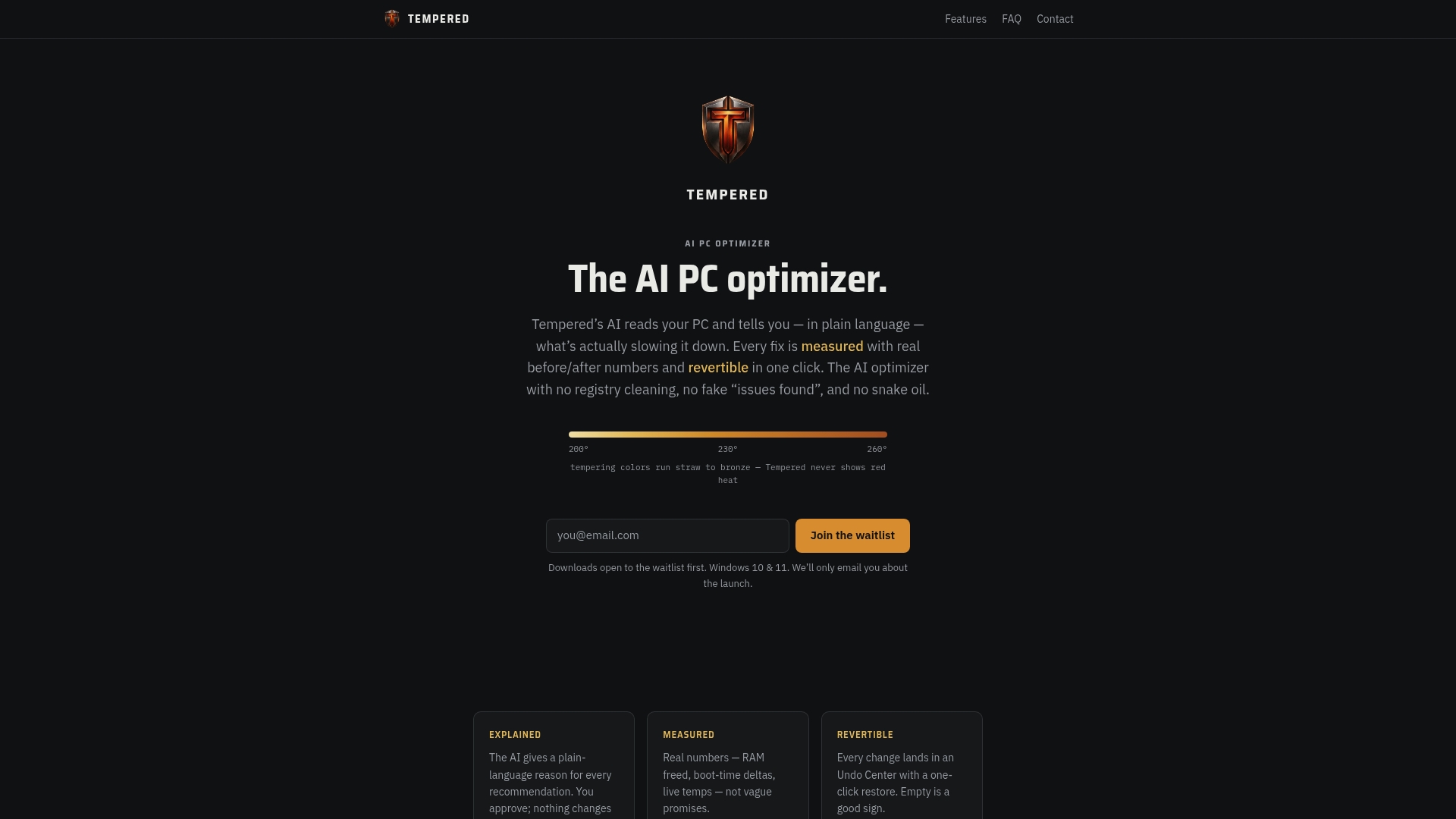
- These tools surface the exact process or setting causing a slowdown, in plain language, before you touch a single folder.
- Recommended changes come with an undo option, so nothing is applied without user approval.
- Features such as Game Mode and startup management help rule out background interference before blaming the shader cache.
Our Free plan runs limited AI scans at no cost, and Torque and Torque Max unlock unlimited scans starting at $5.99 per month if you want ongoing monitoring. Run a scan, see what's actually competing for resources, and decide from there whether the cache needs touching at all.
FAQ
Should I turn on the NVIDIA shader cache?
Yes, shader cache should stay enabled for nearly everyone, since it's what lets the driver skip redoing shader compilation work it's already finished. Turning it off removes that benefit entirely and tends to make loading and in-game hitching worse, not better.
Can I clear the NVIDIA shader cache?
Yes, and NVIDIA documents the exact steps: disable shader cache in the NVIDIA App, reboot, delete the contents of DXCache, GLCache, and NV_Cache, then re-enable the default cache size and reboot again. Clearing it forces the driver to rebuild the cache from a clean state, which resolves most corruption-related issues.
Should I enable or disable shader cache?
Enable it. Disabling shader cache removes the performance benefit it provides and leaves every shader to recompile from scratch on each run, which is the opposite of what most gamers want.
Is it good to delete shader cache?
Deleting shader cache is a reasonable fix when you're seeing crashes, visual artifacts, or stutter that doesn't improve after a few normal game launches, since those symptoms often point to a corrupted cache. It isn't something to do routinely, since the driver needs time to rebuild a useful cache after every deletion.
Sources
- Deleting NVIDIA Shader Cache files
- How to clear your shader cache (Portkey Games support)
- Pre-compiled shader cache cleaned by nvidia driver, causing stutter when launching vulkan apps - NVIDIA Developer Forums
- hl2guide/NVidia-Shaders-Cleaner