Most sudden FPS drops on Windows 11 trace back to three things: power mode settings, a corrupted or outdated GPU driver, or a background app eating CPU cycles. Start by switching your power mode to Best Performance, cleanly reinstalling your GPU driver, and closing heavy background processes while testing fullscreen against borderless windowed mode. These three checks resolve the majority of cases without touching hardware.
TL;DR:
- Switching to the Best Performance power mode and reinstalling GPU drivers with DDU can fix most FPS drops caused by software conflicts.
- Monitoring temperatures, background apps, and storage performance helps identify thermal or streaming issues that cause intermittent frame rate problems.
- Disabling overlays, toggling optimizations, and verifying game files on SSD can resolve FPS drops related to background interference or corrupted assets.
- Many issues stem from Windows updates, driver mismatches, or feature interactions, so checking update history and turning off unnecessary Windows security features can restore performance.
- Using frame time and frametime graphs reveals specific causes like shader stalls, asset streaming, or driver pulses, enabling targeted fixes rather than trial-and-error adjustments.
Table of Contents
- Quick diagnosis checklist you can run in 20 minutes
- What usually causes FPS drops on Windows 11
- Step-by-step fixes from quick wins to advanced changes
- How to measure frame time and read the pattern it leaves behind
- Building settings and habits that keep frame rates steady
- How Tempered complements manual troubleshooting
- Network-related factors causing FPS drops in online games
- Role of antivirus and security software interference on game performance
- Realistic expectations and when to stop troubleshooting
- Try Tempered after your manual fixes to confirm the improvement
- Sources
- FAQ
Quick diagnosis checklist you can run in 20 minutes
Before chasing exotic fixes, rule out the obvious. Open Task Manager (Ctrl+Shift+Esc) and watch the CPU and Disk columns while your game is loading or running in the background.
Here is the order that finds problems fastest:
- Check Task Manager's Processes tab for CPU or disk spikes, then disable suspicious entries under the Startup tab.
- Switch Power Mode to Best Performance in Settings > System > Power, or select the High Performance plan in Control Panel, then relaunch your game.
- Open Device Manager or your GPU vendor's app to confirm the driver version, and note whether a Windows Update installed a generic driver recently.
- Alt+Enter to toggle fullscreen versus borderless, and check Settings > System > Display > Graphics for the per-app "Optimizations for windowed games" toggle, since Microsoft's documentation explains this setting switches compatible DirectX 10/11 titles to a flip-model presentation that improves frame latency.
- If nothing improves, reboot into a clean boot (msconfig > Selective startup > load only essential services) and retest.
Each step takes two to five minutes, so the full pass fits inside a single loading screen's worth of patience. If FPS recovers after any single step, stop there: you have found your cause and do not need to keep digging.
Pro Tip: Run this checklist with the game already installed and a save file ready to load. You want to reproduce the same five-minute test scene each time, not a random play session, so you can trust the comparison.
What usually causes FPS drops on Windows 11
FPS drops rarely come from one universal cause. They cluster into a handful of categories, and matching your symptoms to the right one saves hours of guessing.
- Windows updates: A cumulative update can reset your power plan to Balanced, silently swap your GPU driver for a generic Microsoft or OEM version, or introduce a regression that Microsoft has not yet patched.
- Driver corruption or replacement: Windows Update sometimes installs its own driver package over the vendor driver from NVIDIA, AMD, or Intel, which can behave differently under load even though the version number looks current.
- Windows feature interactions: Hardware-accelerated GPU scheduling, Game Mode, Optimizations for windowed games, Memory integrity (HVCI), and Virtual Machine Platform all add or remove a layer between your game and the GPU, and any one of them can introduce overhead on specific hardware combinations.
- Thermal and resource pressure: Thermal throttling, VRAM running near capacity, or a game streaming assets faster than your storage can deliver them all show up as inconsistent frame delivery rather than a flat low average.
- Background interference: Overlays from chat apps, RGB lighting software, capture tools, and anti-cheat or driver conflicts can each introduce periodic hitches that look like random FPS drops.
Windows updates deserve particular attention because they touch several of these categories at once. A patch can reset your power plan, replace a driver, and change a default feature toggle in the same install, which is why performance sometimes drops right after Patch Tuesday for no obvious reason.
Memory integrity and Virtual Machine Platform are easy to overlook because they live under Windows Security rather than the graphics settings most players check first. Community troubleshooting on Microsoft Q&A notes that these features can add measurable overhead, and turning them off temporarily is a reasonable diagnostic step, with the tradeoff that you lose the security protection they provide while testing.
Thermal throttling has a distinct signature: frame rates stay fine for the first several minutes of a session, then sag gradually as the GPU or CPU heats up, and recover after a few minutes idle. VRAM pressure looks different: FPS craters sharply the moment a new area loads or a texture-heavy scene appears, then partially recovers. Storage streaming stalls produce brief, repeated freezes during fast movement or fast travel, especially on a mechanical hard drive or a nearly full SSD.
Background interference is the hardest category to spot because it is intermittent by nature. Forum reports on Microsoft Q&A describe cases where disabling overlays or specific background services resolved stuttering even though temperatures and driver versions looked completely normal. Separately, TechRadar's coverage of a Microsoft investigation into post-update game crashes points to driver components from RGB and peripheral utilities as a contributing factor in some incidents, with removing the offending driver file or rolling back the update offered as a temporary workaround.
Step-by-step fixes from quick wins to advanced changes
Work through these in order. Each block includes a rough time estimate and a checkpoint so you know whether to move on or stop.
Quick fixes (5 to 20 minutes)
- Set Power Mode to Best Performance (Settings > System > Power) or select the High Performance plan in Control Panel's power options.
- Turn off game bar notifications and background captures under Settings > Gaming if you are not actively recording.
- Close launchers, chat overlays, and browser tabs you do not need during play.
- Test fullscreen against borderless windowed mode with Alt+Enter, and toggle the per-app "Optimizations for windowed games" switch under Settings > System > Display > Graphics to see which combination holds steady frame times.
Checkpoint: if FPS is now stable, you are done. If it still drops, move to drivers.
Driver workflow (20 to 40 minutes)
Download the latest driver from your GPU vendor's site first, but do not install over the old one. Boot into Safe Mode and run Display Driver Uninstaller (DDU) to remove every trace of the current driver, including leftover registry entries that a normal uninstall leaves behind. Reboot normally and install the fresh driver package.

If the newest driver introduces new problems instead of fixing the old ones, roll back to the previous stable version using DDU again, then install from the vendor's archive rather than letting Windows Update choose for you.
Checkpoint: retest your five-minute scene. A clean driver install fixes a large share of stutter cases tied to corrupted or mismatched driver files.
Windows update actions (10 to 30 minutes)
Check Settings > Windows Update > Advanced options > Optional updates for driver packages you did not explicitly choose to install, and uninstall any that landed around the time FPS dropped. If a specific KB update lines up with the start of your problem, uninstall it from Control Panel's update history and pause updates for a few weeks until a fix ships.
Checkpoint: if performance was fine before a specific update and broke after, this step alone often resolves it.
OS settings to toggle (5 to 15 minutes each)
Test these one at a time, not all at once, so you know which change actually mattered:
- Toggle Optimizations for windowed games on and off per-app and compare frame times in each state.
- Toggle Game Mode off under Settings > Gaming to rule out its scheduling behavior on your specific hardware.
- Toggle hardware-accelerated GPU scheduling under Settings > System > Display > Graphics, since our guide to enabling HAGS walks through what to expect in each state.
- Temporarily disable Memory integrity under Windows Security > Device security > Core isolation to test for overhead, then re-enable it once you have your answer.
Pro Tip: Change one setting, run your test scene, write down the result, then change it back before testing the next one. Stacking changes makes it impossible to know which one actually helped.
Thermal and hardware steps (20 to 60 minutes)
Monitor CPU and GPU temperatures during a session using your GPU vendor's software or a monitoring overlay. If temperatures climb steadily above typical ranges for your hardware and FPS sags in step with them, clean dust from your case and fans, check that your GPU's fan curve is responding, and confirm your power supply is not aging past its rated capacity under load. On desktops, reseating the GPU in its slot rules out a loose connection, which is an underrated cause of intermittent drops that look software related.
Storage and streaming steps (10 to 40 minutes)
If drops cluster around loading new areas or fast movement, verify the game is installed on an SSD rather than a mechanical hard drive, since streaming stalls are far more common on HDDs under modern open-world titles. Run a disk cleanup to free space if your drive is nearly full, and use your game launcher's "verify integrity of game files" option to rule out corrupted assets as the source of hitches.
How to measure frame time and read the pattern it leaves behind
Average FPS is a single number that hides the shape of your problem. A game holding 80 FPS on average can still feel rough if every few seconds a frame takes four times longer than normal to render, a hitch the average completely smooths over.
As one in-depth breakdown of stutter at high FPS puts it, you need the frametime graph and 1% lows to catch late frames and match them to a likely cause, since a smooth average can coexist with a genuinely unpleasant play experience.
A frame time spike of even 50 milliseconds registers as a visible stutter, according to frametime analysis that recommends tracking these graphs directly rather than relying on the FPS counter alone, since the counter only reports an average across the last second.
To capture this data, use PresentMon for raw frame timing logs, RTSS (RivaTuner Statistics Server) for a real-time overlay and logging, FrameView for a simpler vendor-agnostic capture tool, and Task Manager's Performance tab or a utility like PC Workman for temperature and utilization context alongside your frame data.
Different problems leave different fingerprints in a frametime graph:
- Shader compile stalls show up as a cluster of large spikes the first time you enter a new area or encounter a new effect, then smooth out on repeat visits.
- Asset streaming stalls look like short, repeated freezes during fast travel or fast movement, worse on slower storage.
- CPU game-thread bottlenecks produce a frame time floor that will not drop no matter how light the GPU load gets, often paired with one CPU core pegged near 100%.
- Driver or overlay pulses appear as regular, evenly spaced spikes, often every few seconds, that line up with a background process or an overlay refresh.
Reproduce the same scene, same route, and same settings before and after each change. Turn off overlays for one comparison run to isolate whether they are contributing, since an overlay-driven pulse tends to disappear the moment you disable the overlay entirely.
Building settings and habits that keep frame rates steady
A stable frame rate is as much about routine as it is about any single fix. A few durable habits keep new regressions from creeping back in.
Capping your frame rate below your monitor's maximum, or below what your hardware can sustain at peak, often feels smoother than leaving it uncapped. Testing covered by XDA Developers found that capping framerate can produce lower latency and a smoother experience than chasing the highest uncapped average, because a cap flattens the frame-time graph and reduces render-queue latency rather than letting the GPU race ahead and then stall.
- Set an in-game or RTSS frame cap a few frames below your monitor's refresh rate to reduce stutter and input latency together.
- Check for GPU driver updates and Windows optional updates every few weeks rather than waiting for a problem to appear.
- Schedule an occasional restart instead of leaving your PC in sleep for days at a time, which clears out accumulated background cruft.
- Review per-app toggles for Auto HDR and Optimizations for windowed games after any driver or Windows update, since Microsoft notes that enabling Auto HDR can implicitly change the windowed-optimizations state for a given title.
- Trim startup apps and limit overlays and monitoring tools to the ones you actually use, since each additional background process is one more thing that can introduce a periodic hitch.
Pro Tip: Keep a simple note of your driver version and Windows build number after a good session. If performance regresses later, you will know exactly what changed in between.
Per-app graphics settings deserve a periodic look too, since a game update can silently reset its own configuration file and re-enable a setting you had turned off, like motion blur or a shadow quality tier that quietly taxes your GPU more than expected.
How Tempered complements manual troubleshooting
Working through driver reinstalls, power settings, and frametime captures by hand teaches you exactly what is wrong, but it takes time, and not every reader wants to run DDU at midnight before a raid. Tempered is built for the gap between "something feels off" and "I have isolated the exact cause."
Tempered reads live CPU, GPU, RAM, disk, and uptime metrics and surfaces the specific constraint holding your system back in plain language rather than a generic score. It does not make silent changes: every recommendation is presented with an explanation of what it does and what to expect, and nothing applies without your approval.
- It measures live CPU, GPU, RAM, disk, and uptime data and identifies the actual bottleneck rather than guessing from a checklist.
- Every suggested change comes with an explanation and an expected outcome before you approve it.
- Each change carries an undo path, so testing a tweak never means losing track of your system's original state.
- It fits naturally after a quick diagnosis checklist, as a way to confirm a fix worked or to catch a constraint missed manually.
Running a scan after you have already tried the manual steps in this guide is a reasonable way to check whether the change you made actually resolved the underlying constraint, or whether something else is still holding your frame rate back. The Free tier is the natural starting point before considering anything more.
Network-related factors causing FPS drops in online games
FPS drops in online games sometimes have nothing to do with your GPU or CPU at all. A spike in network latency or packet loss can cause a game engine to stall briefly while it waits for server data, and depending on how the game is coded, that stall can visibly affect your local frame rate even though your hardware is running fine.
Check your connection with a wired Ethernet cable instead of Wi-Fi where possible, since Wi-Fi interference introduces exactly the kind of intermittent latency spikes that masquerade as FPS drops. Background downloads, cloud backups, or another device on your network saturating bandwidth during a match can produce the same symptom, so closing unnecessary network activity before a session is a simple and often overlooked fix.
Router quality of service settings, VPN overhead, and ISP-level congestion during peak hours can all contribute as well. If drops only happen in online modes and never in single-player or offline testing, treat network conditions as your primary suspect rather than continuing to chase driver or thermal fixes that will not address the actual cause.
Role of antivirus and security software interference on game performance
Security software occasionally interferes with game performance by scanning files in real time as a game streams assets from disk, which can introduce the exact kind of storage-related stutter described earlier in this guide. Third-party antivirus tools are more likely culprits here than Windows' built-in Microsoft Defender, though either can occasionally flag a game's anti-cheat driver or executable and slow it down while inspecting it.
If you suspect this, check whether your antivirus has a gaming mode or an exclusion list, and add your game's installation folder to it. Test a session with real-time scanning temporarily paused to see whether frame times improve, then decide whether a permanent exclusion is worth the small tradeoff in scan coverage for that folder.
Anti-cheat software itself can also conflict with certain drivers or background utilities, which is a separate issue from antivirus interference but produces similar symptoms: periodic hitches tied to a specific background process rather than anything GPU or CPU related.
Realistic expectations and when to stop troubleshooting
Most FPS drops on Windows 11 are fixable through software, drivers, or configuration changes, not hardware replacement. If you work through the quick checklist, the driver workflow, and the Windows update checks in this guide and still see consistent drops, that is the point to suspect hardware rather than before.
Hardware faults have distinct signs: a GPU that throttles at the same temperature every single session regardless of cleaning, visual artifacting on screen, or crashes that appear specifically under sustained stress testing rather than randomly. Those symptoms point toward a dealer or repair conversation, not another driver reinstall.
A reasonable test order is the quick checklist first, at 20 minutes, then the driver workflow, at 40 minutes, then a frametime capture to confirm what is actually happening before you touch anything thermal or hardware related. Skipping straight to reseating components or replacing parts before ruling out software causes wastes time and money on problems that a clean driver install would have solved anyway.
— Ian
Try Tempered after your manual fixes to confirm the improvement
Working through driver reinstalls and settings toggles by hand gets you most of the way there, but confirming the fix actually worked, and catching anything you missed, is where a lot of people give up out of fatigue rather than lack of options. Tempered picks up from exactly that point: it reads your system's current state and tells you in plain language whether the constraint you were chasing is actually resolved.
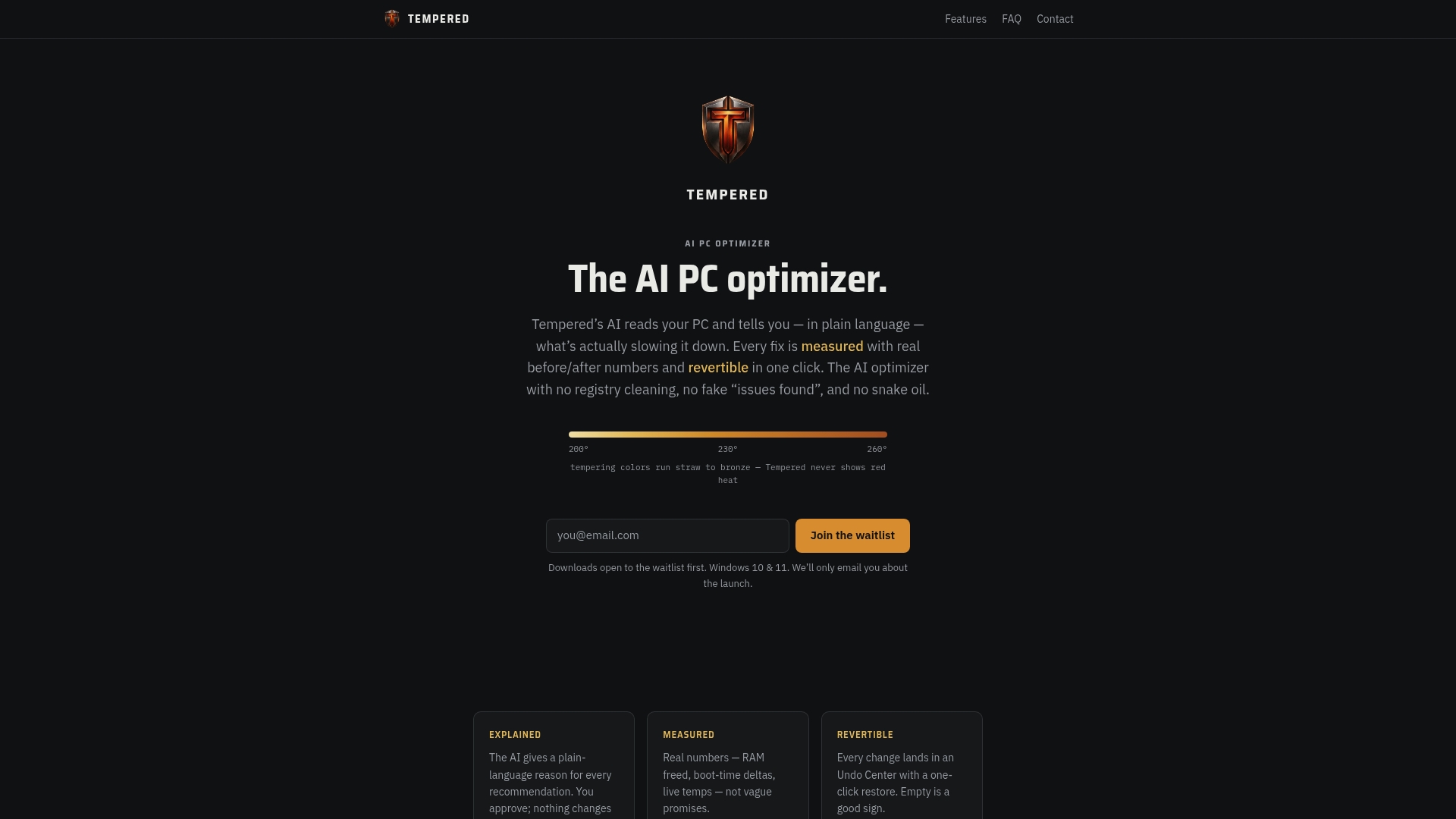
- The Free tier includes a limited number of AI scans, enough to check your system after an attempted fix without committing to anything.
- Every change Tempered suggests comes with a clear explanation and a one-click undo, so nothing happens to your system without your approval.
- If you find yourself running scans regularly or want unlimited checks, the Torque and Torque Max plans unlock higher scan limits and additional features, both detailed on the pricing page.
Running a scan right after you make a change, whether that is a driver reinstall or a power plan switch, is a fast way to see whether the underlying constraint is actually gone or just temporarily quieter. Start with a free scan and see what it finds before deciding whether a paid plan is worth it for your setup.
Sources
- Optimizations for windowed games in Windows 11 | Microsoft Support
- Game stutters at high FPS: frame time and 1% lows (PC Workman)
- Chasing highest average framerate makes your games feel worse — when to cap FPS (XDA Developers)
FAQ
Why did my PC FPS suddenly drop?
A sudden FPS drop usually follows a Windows update, a driver change, or a new background process starting up, any of which can reset your power plan or introduce a conflict. Run the quick diagnosis checklist first: check Task Manager for spikes, confirm your power mode, and verify your GPU driver version.
Why is my PC so laggy all of a sudden in Windows 11?
Sudden lagginess often comes from a background process consuming CPU or disk resources, a recent driver replacement by Windows Update, or a Windows feature like Memory integrity adding overhead on your specific hardware. Check Task Manager first, then work through the driver and Windows update steps in this guide if the problem persists.
Is Windows 11 25H2 causing slow performance?
Individual Windows updates have occasionally caused game stuttering or crashes for some users, with TechRadar reporting Microsoft investigating driver conflicts tied to specific update rollouts. If performance dropped right after an update, check Optional updates for a suspect driver package and consider uninstalling the update until a fix ships.
Why is my FPS constantly dropping?
Constant, repeated FPS drops usually point to a background process, an overlay, thermal throttling, or a storage bottleneck rather than a one-time glitch. Capturing a frame time trace with PresentMon or RTSS will show whether the drops are evenly spaced, which points to a background process, or scene-specific, which points to asset streaming or shader compilation.