
Turn off Discord's hardware acceleration and overlay, then check Task Manager or top/htop to confirm Discord is actually the process pulling your CPU up. Those two toggles resolve most reported spikes within minutes. If usage stays high after that, move on to cache clearing, driver updates, and a clean reinstall in that order.
TL;DR:
- Disabling hardware acceleration and the overlay can resolve most CPU spikes within minutes, especially on older or conflicting graphics drivers.
- Confirm Discord is causing the high CPU by inspecting per-core usage and sub-processes in Task Manager or
top/htopon Linux, rather than relying on aggregate percentages.- Most high CPU reports stem from features like hardware acceleration, overlays, or continuous voice processing, which can be toggled off to improve performance.
- High CPU during streaming or screen sharing usually indicates encoder issues; dropping resolution or switching encoders can alleviate the load.
- Persistent spikes may require updating GPU drivers, checking system power plans, or performing a clean reinstall of Discord before escalating to support.
Table of Contents
- 1. Priority quick fixes for Windows and Linux
- 2. How to confirm Discord is the culprit and what data to collect
- 3. Discord settings that commonly cause high CPU and how to change them
- 4. Troubleshooting Go Live, screen share, and streaming-related CPU spikes
- 5. Drivers, WMI, runtime broker, and power plan fixes that resolve persistent spikes
- 6. Clean reinstall and escalation: when to reset Discord or file a bug report
- 7. Expert checklist and diagnostic approach
- 8. Author perspective: what I usually see and when to worry
- 9. Try Tempered for tracked diagnostics and reversible optimizations
- 10. Official docs and patch notes that back these fixes
- Sources
- FAQ
1. Priority quick fixes for Windows and Linux
Start with the changes that take thirty seconds and fix the majority of cases before touching anything else on your system.
- Disable hardware acceleration: open Discord settings, go to Advanced, and toggle off "Hardware Acceleration," then restart the app. Discord renders through your GPU by default, and on older or conflicting drivers that handoff can push CPU usage up instead of down.
- Turn off the overlay: in Settings, go to Overlay and disable it globally, or open Game Settings to disable it per title. Overlays inject themselves into running game processes, and a bad hook can spike a single core.
- Clear the cache: on Windows, close Discord and delete the contents of
%appdata%\discord\Cache. On Linux, clear~/.config/discord/Cacheand restart the client. Discord's own troubleshooting guide lists this as a first-line fix for performance issues. - Turn off voice processing extras: disable noise suppression and echo cancellation if you are not on a call, since these run continuously in the background.
- Enable reduced motion: under Accessibility, turn on "Reduce Motion" to cut animation-driven rendering load.
- Run with adjusted permissions: on Windows, try running Discord as administrator once to rule out permission conflicts; on Linux, confirm your user has proper read and write access to the Discord config directory.
Pro Tip: Restart Discord fully (not just close the window) after each toggle so the change actually takes effect before you test the next one.
2. How to confirm Discord is the culprit and what data to collect
Before changing more settings, verify Discord is actually the process responsible, not something running alongside it.
- On Windows, open Task Manager, go to the Processes tab, and sort by CPU. Then check the Performance tab's per-logical-processor view, since a single overloaded thread can show 100% on one core while total CPU usage looks moderate.
- The Details tab breaks Discord into its sub-processes (renderer, GPU process, utility processes), which helps you see whether the spike is coming from rendering, networking, or a helper process.
- On Linux, run
toporhtopand sort by CPU, then useps -T -p <pid>to see which individual thread inside Discord is active. - Locate Discord's log folder (
%appdata%\discord\logson Windows,~/.config/discord/logson Linux) before you file a report, since these files show what was happening at the time of the spike.
Per-core readings matter more than the total. Microsoft's guidance on high CPU usage explains that inspecting logical processor graphs, rather than the aggregate CPU percentage, is the reliable way to catch a single-threaded bottleneck that a summary view would hide.
3. Discord settings that commonly cause high CPU and how to change them
A handful of toggles inside Discord account for most of the spikes people report, and each one trades a feature for CPU headroom.
- Hardware acceleration: offloads rendering to your GPU, but on some driver and hardware combinations it backfires and raises CPU load instead of lowering it. Turning it off forces software rendering, which is often steadier even if slightly less efficient on capable hardware.
- Overlay: hooks into each game process individually, and a conflict with that hook is a common source of spikes during play. Discord's Player release from Q1 2025 introduced a revamped overlay architecture that reduces how deeply it hooks into game processes, but Discord still recommends disabling it per-game if problems continue.
- Noise suppression and echo cancellation: run continuous audio processing in the background during voice calls, so disabling them helps most on older CPUs.
- Reduced motion and server list virtualization: cut down on constant UI redraws, which matters most if you belong to many servers or run Discord on a lower-power machine.
4. Troubleshooting Go Live, screen share, and streaming-related CPU spikes
If high CPU only shows up while streaming or sharing your screen, the encoder is almost always the source.
- Lower your stream resolution or frame rate first as a quick test. Discord's engineering notes on improving Go Live video quality describe how encoder bottlenecks can create a feedback loop where the encoder keeps reconfiguring itself, and dropping resolution or frame rate often breaks that loop.
- Check whether you are using a hardware encoder like NVENC (NVIDIA) or Quick Sync (Intel); switching between hardware and software encoding can isolate whether the GPU or CPU is struggling.
- On certain AMD hardware and driver combinations, Discord can get stuck in an RTC_CONNECTING loop that repeatedly reinitializes the encoder and holds CPU near 100%. Discord's AMD GPU RTC troubleshooting guide recommends disabling the OpenH264 codec or switching encoders to stop the loop.
- Disable the overlay and repeat your stream test, since overlay interference during screen share is common enough to rule out separately.
Pro Tip: If CPU only spikes during Go Live and not during normal voice calls, the encoder, not Discord's core app, is almost certainly the bottleneck.
5. Drivers, WMI, runtime broker, and power plan fixes that resolve persistent spikes
When app-level fixes do not hold, the cause usually sits underneath Discord rather than inside it.
- Update your GPU drivers through the manufacturer's own tool rather than Windows Update alone, and check for a pending BIOS or firmware update if the machine is older.
- If Task Manager shows WMI Provider Host or Runtime Broker pulling high CPU, investigate before ending either process, since both support legitimate system functions and killing them can cause other issues.
- Check advanced boot options to confirm your system has not been limited to a single CPU core, and review your power plan since some balanced or power-saver profiles throttle performance under load.
- On Linux, update your GPU and kernel packages, then check
dmesgfor driver errors that coincide with the spikes.
6. Clean reinstall and escalation: when to reset Discord or file a bug report
When every setting change fails, a clean reinstall rules out a corrupted install before you escalate further.
- Uninstall Discord completely, then delete
%appdata%\discordon Windows or~/.config/discordon Linux to remove leftover cache and settings. - Reinstall the latest stable build from Discord's own site, or try the PTB build to check whether a recent release caused a regression.
- If the problem persists, file a report with Discord support and attach your log folder along with a screenshot of Task Manager's per-core view.
7. Expert checklist and diagnostic approach
A measurement-first approach saves time before you start changing settings at random.
- Record per-core CPU load in Task Manager or htop before and after each change, so you know what actually worked.
- Check your GPU encoder for errors if the spike only happens during streaming or Go Live.
- Watch Discord's sub-process timeline in the Details tab to see whether the renderer, GPU process, or a utility process is driving the load.
- Run a quick bandwidth test, since Discord's own Voice and Video streaming guide lists network checks alongside hardware acceleration and overlay toggles as standard troubleshooting steps.
Tempered approaches this kind of diagnosis by measuring live CPU, GPU, and process data on your machine, then proposing specific, reversible changes rather than blanket tweaks, which suits readers who want a system-wide read on what else might be competing with Discord for CPU time. For deeper command-line diagnostics on Windows, including how to isolate a CPU hog on Windows 11 or check whether GPU usage rather than CPU is the real constraint, Ian's other troubleshooting posts go a level deeper than this guide.
8. Author perspective: what I usually see and when to worry
Short spikes during Go Live or screen share are normal and usually settle once you drop resolution or frame rate. Sustained 100% usage while Discord sits idle is not normal and points to a setting, driver, or corrupted cache. Collect logs and per-core readings before making big changes, and favor the reversible fixes first.
— Ian
9. Try Tempered for tracked diagnostics and reversible optimizations
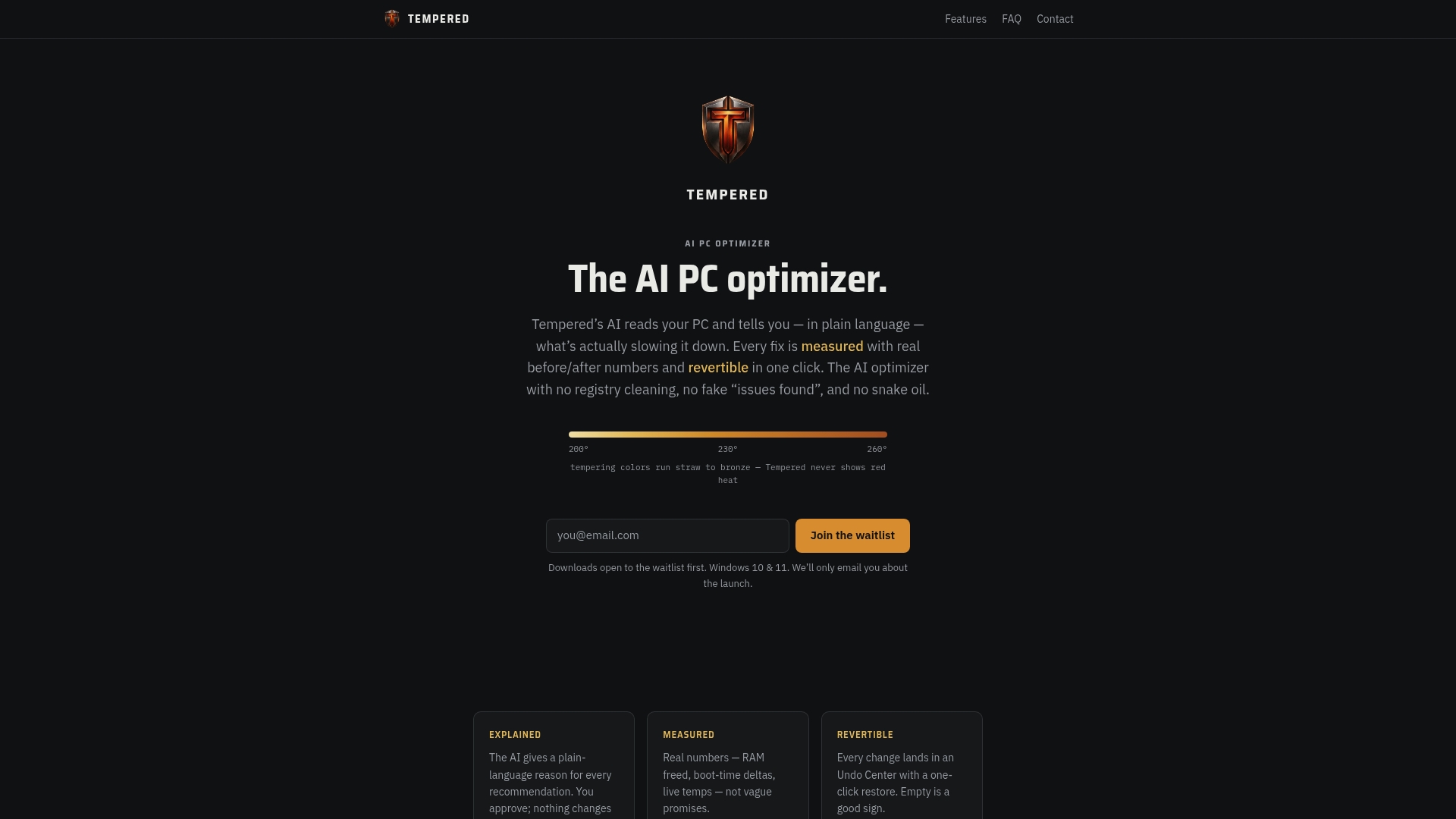
If you have already worked through hardware acceleration, overlay settings, and a cache clear and Discord is still pulling your CPU up, the issue is probably tangled up with something else running on your machine, and that is a harder thing to spot by eye. Tempered scans your live hardware metrics (CPU, RAM, GPU, disk, and uptime), flags background processes that are actually competing with Discord for resources, and proposes specific changes with plain-language explanations and a one-click undo for each one.
- It never applies a change without your approval first.
- Every tweak comes with an explanation of what it does and why it is being suggested.
- You can revert any single change without touching the others.
The Free plan covers a limited number of AI scans if you want to see what it flags on your own machine, and the Torque and Torque Max plans unlock unlimited scans and the full set of optimization tools. Start with a scan on the Tempered landing page and see what else might be behind the slowdown.
10. Official docs and patch notes that back these fixes
- Discord's troubleshooting guide covers cache clearing, hardware acceleration, and overlay steps in detail.
- Discord's patch notes from February 4, 2026 document render performance fixes tied to CSS selector issues.
- Microsoft's Task Manager support tools documentation explains how to read per-logical-processor data correctly.
Sources
- Discord blog — Player release Q1 2025
- Discord support — Troubleshooting guide
- Discord patch notes — February 4, 2026
FAQ
Why is Discord using 90% of my GPU?
This usually points to hardware acceleration pushing rendering work onto your graphics card, or an overlay hooking into a running game. Turning off hardware acceleration in Discord's Advanced settings and disabling the overlay are the two fixes to try first.
Is Discord CPU-intensive?
Discord is not inherently heavy, but certain settings, especially hardware acceleration, the overlay, and voice processing features like noise suppression, can drive CPU usage up on some hardware. Disabling those settings and checking Task Manager's per-core view typically brings usage back down.
How do I fix my CPU usage so high?
Start by confirming the actual source with Task Manager on Windows or htop on Linux, since another process might be the real cause. If Discord is confirmed as the source, disable hardware acceleration and the overlay, clear the cache, and update your GPU drivers before considering a clean reinstall.
Why is Discord taking up so much memory on my computer?
Discord runs several sub-processes for rendering, GPU handling, and utility tasks, and each one holds its own memory allocation, which adds up in Task Manager. Server list virtualization improvements and clearing the cache can reduce this footprint if it climbs unusually high.