
You can change a Windows process's CPU priority right now from Task Manager, but the change disappears the moment you close the app or restart your PC. Pushing a process to High or Realtime can starve system tasks and freeze your screen, so treat those levels as a last resort, not a tune-up.
- Open Task Manager (Ctrl+Shift+Esc)
- Click the Details tab, then right-click any process to set its priority
Pro Tip: If you're not actively diagnosing a stuck program or a slow render, leave priority alone. The scheduler is already doing this job better than a manual guess.
Key Takeaways
Setting a process's priority through Task Manager is fast and temporary, while genuine performance gains almost always come from fixing the underlying bottleneck, not the scheduler.
| Point | Details |
|---|---|
| Use Task Manager for quick changes | Details tab, right-click, Set priority, works instantly but resets on restart. |
| Avoid Realtime almost always | It can block disk cache flushes and input handling, mimicking a system freeze. |
| Affinity and priority differ | Affinity picks which cores a process can use; priority sets scheduling preference. |
| Persist changes with shortcuts or scripts | Use start /HIGH, PowerShell's -Priority, or a Scheduled Task, not registry edits. |
| Automate recurring tuning | Tempered applies reversible, metrics-driven changes instead of one-off manual edits. |
Table of Contents
- How Do You Set Process Priority in Task Manager?
- What Do Realtime, High, and the Other Priority Levels Actually Mean?
- Processor Affinity vs. Process Priority: What's the Difference?
- How Do You Make a Priority Change Stick After Restart?
- What Should Developers Know About SetPriorityClass and SetThreadPriority?
- How Do You Troubleshoot a Bad Priority Change?
- Are Automated Optimizers Safer Than Manual Priority Tweaks?
- When I'd Actually Touch Process Priority
- A Safer Way to Tune Background Tasks on Windows
- Sources
How Do You Set Process Priority in Task Manager?
Changing a process's priority takes under a minute, and Windows 10 and 11 use the same path.
- Press Ctrl+Shift+Esc to open Task Manager.
- Click the Details tab.
- Right-click the process you want to adjust.
- Select Set priority, then pick a level: Realtime, High, Above normal, Normal, Below normal, or Idle.
- Confirm the warning prompt if one appears (it will, for Realtime).
Prefer the command line? PowerShell and Command Prompt both work:
Get-Process notepad | ForEach-Object {$_.PriorityClass = "High"}sets priority through PowerShell.start /HIGH notepad.exelaunches a program directly at High priority.- Both may require an elevated (administrator) prompt, especially for Realtime.
To confirm the change stuck, reopen Task Manager's Details tab and check the Priority column. Watch the CPU column for a minute or two afterward, since a genuinely CPU-bound task should show a shift in how much time it grabs relative to neighboring processes.
Pro Tip: If Task Manager's Priority column reverts to Normal after a few seconds, another program (often the app itself) is resetting it. That's a sign the app manages its own thread priority internally.
What Do Realtime, High, and the Other Priority Levels Actually Mean?
Windows uses six priority classes, and most people only ever need one of them: Normal.
- Realtime sits above the operating system's own background maintenance work. SetPriority documentation notes this class is reserved for OS-level, highest-priority work, and setting it may require the SeIncreaseBasePriorityPrivilege.
- High is meant for short, time-critical tasks, not everyday apps you want to feel faster.
- Above normal gives a modest scheduling edge without the risk profile of High.
- Normal is the default for nearly every process on your machine, and it's correct almost all the time.
- Below normal politely steps back so foreground work gets first access to the CPU.
- Idle is for tasks that should only run when literally nothing else needs the processor, like a batch file indexer.
The risk concentrates at the top. Pushing a process to Realtime can block essential OS work like flushing disk caches or handling input, which produces symptoms that look exactly like a frozen system. High priority processes can crowd out normal ones badly enough to make your mouse stutter.
Realtime isn't "extra fast." It's a promise to Windows that this task matters more than the disk cache, the keyboard driver, and everything else running. Most programs have no business making that promise.
Rule of thumb: Idle for silent background batch jobs, Normal for everything else, Above normal or High only for a brief, deliberate test, and Realtime essentially never.
Processor Affinity vs. Process Priority: What's the Difference?
Priority tells the scheduler how eagerly to run a process. Affinity tells it which cores it's allowed to use at all. They solve different problems, and confusing them is a common mistake.
Processor affinity works through a bitmask, one bit per logical core, and Task Manager's Details tab exposes it as "Set affinity" with a checkbox list. It's genuinely useful for isolating a misbehaving thread during testing, far less useful as a permanent fix, since locking a process to one core often just slows it down.
- Affinity: which cores can run this process
- Priority: how much scheduling preference it gets on those cores
Pro Tip: Set affinity via start /affinity in a shortcut if you need it every time a specific program launches, rather than resetting it manually each session.
How Do You Make a Priority Change Stick After Restart?
Here's the catch nobody mentions upfront: Task Manager's priority change resets the instant the app closes or the PC reboots. There's no persistent setting hidden in Settings for this.
Three workarounds actually hold up:
- Shortcut with a command. Right-click a desktop shortcut, edit its target to
cmd /c start /HIGH "" "C:\Path\To\App.exe", and it launches at that priority every time. - PowerShell script.
Start-Process "app.exe" -Priority "High"does the same thing and is easier to fold into a scheduled routine. - Scheduled Task. Create a task in Task Scheduler that launches the program through one of the commands above, useful if the app starts automatically at login.
- Registry hacks that claim to force permanent priority are unreliable and often ignored by newer Windows builds.
- Realtime almost always needs administrator rights, tied to the SeIncreaseBasePriorityPrivilege.
- Community testing confirms
start /affinityand PowerShell's ProcessorAffinity property are the practical, repeatable ways to apply this at launch rather than by hand each time.
Pro Tip: Test your shortcut once by watching the Priority column in Task Manager right after launch. A typo in the command silently falls back to Normal.
What Should Developers Know About SetPriorityClass and SetThreadPriority?
If you're writing code instead of clicking through Task Manager, the relevant Win32 calls are SetPriorityClass, which sets a process's priority class, and SetThreadPriority, which adjusts an individual thread's priority relative to that base class.
- A thread never exceeds what its process class allows; the process sets the ceiling, the thread negotiates within it.
- Elevating to REALTIME_PRIORITY_CLASS from code requires the same SeIncreaseBasePriorityPrivilege as the GUI path.
- Real-time audio and video pipelines are the classic legitimate use case, where a missed deadline means an audible glitch.
A process is the class; a thread is the negotiation within it. Get that backwards and your "high priority" thread does nothing, because the process itself never asked for the boost.
Developers working on latency-sensitive audio pipelines specifically should look at how thread priority interacts with buffer scheduling before reaching for Realtime as a blanket fix.
How Do You Troubleshoot a Bad Priority Change?
Before touching priority at all, rule out the usual suspects. A process that seems slow because of "bad scheduling" is often actually starved for RAM, waiting on a strained disk, or fighting thermal throttling that mimics a CPU bottleneck.
- Check current CPU load and memory pressure in Task Manager or Resource Monitor before assuming priority is the problem.
- Rule out disk contention with a quick SSD health check, since a failing drive can look exactly like a CPU issue.
- Confirm temperatures aren't the real culprit; monitoring CPU temps takes two minutes and rules out throttling.
To undo a bad change, reopen Task Manager's Details tab, right-click the process, and set it back to Normal, or simply close the app and relaunch it since the change never persisted anyway.
- Watch for a spike in System or Interrupts process CPU usage after your change, a sign you've starved something critical.
- Watch for rising page faults in Resource Monitor, which points to memory pressure rather than a priority problem.
- If the mouse or keyboard lags, drop the priority back immediately rather than waiting it out.
Are Automated Optimizers Safer Than Manual Priority Tweaks?
Microsoft's own guidance is blunt on this: the scheduler is already tuned for modern workloads, and manual priority or affinity overrides usually do more harm than good outside of narrow troubleshooting scenarios. Community write-ups back this up, repeatedly cautioning against Realtime and broad elevation of multiple processes at once.
The core problem with manual tweaks is that they're brittle. You set a priority once, forget about it, and it either resets on restart or quietly causes a stutter three weeks later when a different app needs that CPU time. An automated, metrics-driven optimizer like Tempered makes the same kind of decision, but reversibly and based on live hardware data instead of a one-time guess.
- Manual priority: fast, but ad-hoc and forgotten quickly
- Automated optimization: slower to set up once, but reversible and reevaluated as conditions change
Pro Tip: Reserve manual priority changes for a specific, short-lived diagnostic. If you find yourself doing it weekly, that's a sign to automate the decision instead of repeating it by hand.
When I'd Actually Touch Process Priority
I only change priority when I'm isolating a specific problem, like confirming a render tool is CPU-bound before I decide whether more cores would help. It's a diagnostic tool, not a performance strategy.

Do: use it briefly, on one process, then reset it. Don't: set Realtime, leave a High priority process running for days, or treat this as your go-to fix for a sluggish PC.
A Safer Way to Tune Background Tasks on Windows
Manual priority edits and affinity masks work for a five-minute diagnostic, but they're a poor substitute for actually knowing what's slowing your PC down. Tempered scans your live CPU, RAM, GPU, and disk metrics, then proposes specific, plain-language changes instead of a blind Realtime toggle.
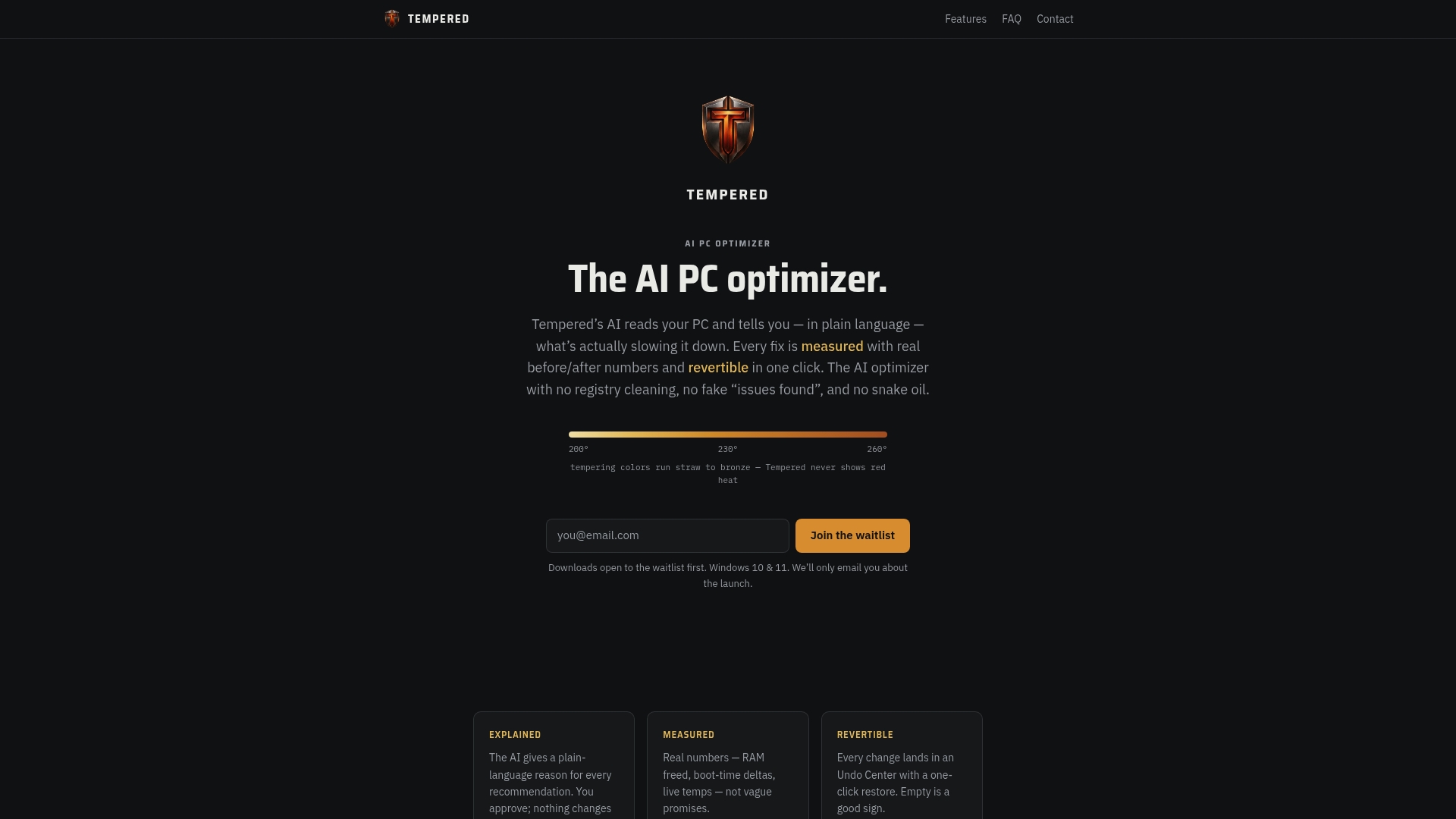
Every suggestion comes with an expected outcome and a one-click undo, so you're never guessing whether a change helped or made things worse. That's the real gap with hand-set priorities: there's no undo button once you've forgotten which process you nudged last week. If your PC feels sluggish and you're tired of chasing it process by process, try Tempered and let it flag the actual constraint instead of a symptom.