Press Win + Ctrl + Shift + B right now. Your screen will flash briefly, you may hear a short beep, and your display should come back shortly. That single shortcut resets the graphics subsystem without closing any open apps — it's the fastest way to restart the graphics driver on any Windows version from 7 through 11. If your screen is frozen, flickering, or showing corrupted output, try this first.
What to expect when you press the shortcut:
- A brief black flash lasting one to two seconds
- A possible short beep (more common on older Windows versions)
- Open apps stay running, though GPU-accelerated programs like games or video editors may lose their graphics context and need a restart
- The desktop returns to normal if the issue was a stalled display pipeline
Save your work before trying anything beyond the shortcut. Device Manager and PowerShell methods can black the screen for longer, and some steps require a full reboot.
Pro Tip: If you're in a Remote Desktop session, Win + Ctrl + Shift + B won't work — the shortcut doesn't pass through RDP. Use Device Manager or PowerShell from the remote session instead.
Key Takeaways
The fastest way to restart a graphics driver is Win + Ctrl + Shift + B, which resets the WDDM display pipeline in seconds without closing open apps or requiring admin rights.
| Point | Details |
|---|---|
| Start with the shortcut | Win + Ctrl + Shift + B resets the display pipeline in seconds; no admin rights needed on Windows 7 through 11. |
| Device Manager is the next step | Disable then re-enable the display adapter when the shortcut fails; requires admin rights and blacks the screen briefly. |
| Roll back when a new driver caused the issue | Use Device Manager's Driver tab to roll back, or use DDU in Safe Mode for a clean reinstall on persistent corruption. |
| RDP and enterprise environments need a different approach | The shortcut doesn't work over Remote Desktop or on Group Policy-managed machines; use PowerShell or Device Manager instead. |
| Tempered for recurring issues | Tempered's AI diagnostics identify the root causes behind repeated driver restarts on Windows 10/11. |
Table of Contents
- Three ways to restart the graphics driver fast
- How the Win + Ctrl + Shift + B shortcut actually works
- How to restart the GPU driver through Device Manager
- When to update, reinstall, or roll back your GPU driver
- What vendor tools can do for GPU driver problems
- Which method should you try first?
- When restarting the driver doesn't fix the problem
- Why these steps are reliable
- A note on what actually goes wrong most often
- Tempered helps when driver restarts keep happening
- Sources
Three ways to restart the graphics driver fast
The fastest path: Win + Ctrl + Shift + B requires no admin rights and takes two seconds. Device Manager is the next step when the shortcut fails. PowerShell is the right tool for admins managing multiple machines or remote endpoints.
Here's the one-line version of each method:
- Win + Ctrl + Shift + B — press and hold all four keys simultaneously; works on Windows 7 through 11, no admin rights needed, screen flashes and recovers in seconds
- Device Manager disable/re-enable — open Device Manager, expand Display adapters, right-click your GPU, disable it, wait three seconds, then re-enable; requires admin rights
- PowerShell — run
Get-PnpDevice -Class Display | Disable-PnpDevice -Confirm:$false, wait, then runGet-PnpDevice -Class Display | Enable-PnpDevice -Confirm:$false; scriptable and auditable for IT admins managing multiple endpoints
According to Microsoft's keyboard shortcut documentation, shortcut behavior can vary by application and system configuration — which is exactly why Device Manager and PowerShell exist as fallbacks.
How the Win + Ctrl + Shift + B shortcut actually works
The shortcut doesn't reinstall your driver. What it does is tell the Desktop Window Manager to recreate its graphics surface and reset the WDDM pipeline, which clears most display-rendering stalls without touching the underlying driver files. Think of it as a soft reset for the display stack, not a full driver reload.
Steps:
- Make sure you're on a local Windows session (not Remote Desktop)
- Press and hold Win + Ctrl + Shift + B simultaneously for about one second
- Release all four keys
- Watch for the screen flash — it confirms the reset fired
- Wait up to five seconds for the display to fully recover
If the screen comes back and the issue is gone, you're done. If the display returns but the problem persists, the issue is deeper than a stalled DWM surface and you'll need Device Manager or a driver update.
Why it might not work:
- Remote Desktop sessions block the shortcut entirely
- Group Policy on managed enterprise machines can restrict Win-key shortcuts
- Legacy or virtual GPU drivers that don't follow the WDDM model won't respond
- Some full-screen applications intercept the key combination before Windows sees it
Pro Tip: Use the shortcut first for any blank screen or UI freeze on a local machine. Skip straight to Device Manager if you're on a laptop with both integrated and discrete GPUs and the shortcut doesn't help — hybrid GPU setups sometimes need the specific adapter reloaded.
How to restart the GPU driver through Device Manager
Before you start: this method blacks the screen for several seconds. Save all open work first.
Steps:
- Press Win + X and select Device Manager (or search for it in Start)
- Expand the Display adapters section
- Right-click the GPU you want to reset and select Disable device
- Confirm the prompt — the screen will go black
- Wait a few seconds
- Right-click the same adapter and select Enable device
- The display driver reloads and the screen returns
What this actually does: disabling the adapter unloads the driver from memory, clears VRAM allocations, and forces Windows to reinitialize the full driver stack on re-enable. That's a more thorough reset than the keyboard shortcut and fixes driver-state corruption the shortcut can't touch.
Watch for these issues:
- If you don't see your GPU listed, expand Other devices — a driver problem may have moved it there
- On laptops with both Intel integrated and NVIDIA or AMD discrete graphics, disable and re-enable the discrete GPU first; the integrated GPU keeps the screen alive during the process
- If the device shows a yellow warning icon after re-enabling, the driver failed to load — proceed to the update or reinstall steps below
- Admin rights are required; if the disable option is grayed out, you're not running as an administrator
When to update, reinstall, or roll back your GPU driver
Not every display problem calls for a full driver reinstall. Here's how to decide:
| Symptom | Recommended action |
|---|---|
| Occasional flicker or blank screen | Shortcut or Device Manager restart first |
| New driver caused crashes or artifacts | Roll back via Device Manager |
| Persistent errors after restart | Overinstall latest driver from vendor |
| Corruption after failed install | Clean reinstall using DDU in Safe Mode |
| Driver version very outdated | Update via vendor utility or Windows Update |
Updating: open Device Manager, right-click your GPU, and choose Update driver. For more control, download directly from NVIDIA, AMD, or Intel's driver pages and run the installer. NVIDIA's driver FAQ notes you can choose to Run the installer directly or Save it first — saving is useful if you want to keep the file for a clean reinstall later.
Overinstalling vs. uninstalling first: current vendor guidance favors running the new installer over the existing driver rather than removing it first. Overinstalling preserves your control panel profiles and settings. Only uninstall first when you're dealing with persistent corruption.
Rolling back: open Device Manager, right-click your GPU, select Properties, go to the Driver tab, and click Roll Back Driver. This option is only available if Windows saved the previous driver package.
Clean reinstall with DDU: download Display Driver Uninstaller and run it in Safe Mode for a complete wipe before installing a fresh driver. Use this for stubborn corruption, not routine updates.
Pro Tip: Note your current driver version before updating by checking through Device Manager. If the new driver causes problems, you'll know exactly what to roll back to. Also check GPU driver update guidance for version-specific advice.
What vendor tools can do for GPU driver problems
NVIDIA GeForce Experience, AMD Adrenalin, and Intel Graphics Command Center all handle driver updates and can simplify the process for most users.
What they offer:
- Automatic detection of the latest driver for your specific GPU model
- One-click installation with options for clean install or express install
- Driver rollback to the previous version within the app
- Basic diagnostic logs and overlay tools that can surface performance issues
Practical use: if you're not sure which driver version to download, open your vendor app and let it identify the right package. GeForce Experience, for example, shows your current driver version alongside the latest available and flags Game Ready or Studio driver branches separately.
Where they fall short: vendor apps install background services that run at startup. On hybrid GPU laptops, these services can occasionally delay driver reinitialization after a restart. If you're troubleshooting a hybrid system and the vendor app's update didn't fix the problem, a manual Device Manager reinstall or DDU clean install often works when the app-based install didn't.
| Vendor tool | Best for | Limitation |
|---|---|---|
| NVIDIA GeForce Experience | Driver updates, Game Ready branch | Adds background services |
| AMD Adrenalin | Driver updates, Radeon settings backup | Can conflict on hybrid systems |
| Intel Graphics Command Center | Intel integrated GPU management | Limited rollback options |
Which method should you try first?
Match your symptom to the right starting point:
- Blank or black screen, frozen UI on a local machine — start with Win + Ctrl + Shift + B; it's non-destructive and takes two seconds
- Shortcut didn't help or you're on a hybrid GPU laptop — move to Device Manager disable/re-enable
- Crashes, TDR errors, or driver-version issues — update or roll back the driver
- Remote desktop or enterprise managed endpoint — skip the shortcut; use Device Manager or PowerShell directly
- Virtual machine or legacy GPU — the shortcut won't work; Device Manager is your first real option
- IT admin managing multiple machines — PowerShell with
Get-PnpDeviceis the scalable path; filter byFriendlyNameorInstanceIDon multi-GPU systems to avoid disabling the wrong adapter
Pro Tip: Before relying on the shortcut, confirm your GPU uses a WDDM-compliant driver. Open Device Manager, right-click your GPU, select Properties, then the Driver tab — if the driver model says "Microsoft Basic Display Adapter," the shortcut won't trigger a real GPU reset.
When restarting the driver doesn't fix the problem
Some display issues aren't driver-state problems — they're hardware faults or deep corruption that no restart will touch.
Signs you're past a simple driver fix:
- TDR (Timeout Detection and Recovery) errors repeat after every reboot
- Error Code 43 in Device Manager after re-enabling the adapter
- Artifacts, lines, or color distortion visible on an external monitor (rules out a cable issue)
- The problem persists in Windows Safe Mode with basic display drivers
Diagnostic steps to take:
- Open Event Viewer (search in Start) and check Windows Logs > System for entries tagged "display" or "nvlddmkm" (NVIDIA) or "amdkmdag" (AMD)
- Test a different cable and a different monitor or TV to isolate the GPU from the display chain
- Boot to Safe Mode and check if the issue disappears — if it does, a third-party driver or software is the cause
- Run a GPU stress test (FurMark is widely used) to check for thermal throttling or hardware instability
- Check GPU temperatures under load using system resource monitoring — sustained temperatures above 90°C on most consumer GPUs indicate a cooling problem, not a driver one
Contact your GPU manufacturer's support or check your warranty status if hardware failure is suspected. A GPU that consistently triggers TDR errors or shows Error Code 43 after a clean driver install is a strong candidate for replacement.
Why these steps are reliable
The methods in this guide come from primary vendor and platform documentation:
- The Win + Ctrl + Shift + B shortcut behavior is documented by Dell's support knowledge base and corroborated by TechRadar's reset guide
- Microsoft's keyboard shortcut reference covers the shortcut's scope and configuration-dependent behavior
- Driver overinstall and rollback guidance comes directly from NVIDIA's driver FAQ
- PowerShell and Device Manager methods are detailed in NinjaOne's Windows 11 driver restart guide
For readers dealing with recurring driver issues rather than a one-time fix, Tempered's diagnostics can surface the underlying performance constraints that make driver restarts a recurring event.
A note on what actually goes wrong most often
The keyboard shortcut fixes more problems than people expect — and fewer than they hope. Most blank-screen and freeze events on a healthy system are DWM surface stalls, not driver crashes, which is exactly what Win + Ctrl + Shift + B is built for. The mistake most users make is skipping straight to a full driver reinstall when a two-second shortcut would have done it.
The cases where I see things go sideways are almost always hybrid GPU laptops after a driver update. The discrete GPU gets a new driver, the integrated GPU doesn't, and the mismatch causes context-loss errors that look like driver crashes but are really synchronization failures. The fix isn't a reinstall — it's updating both GPU drivers to versions that were released together.
A few small habits that consistently improve outcomes: disable third-party overlays (Discord, Steam, GeForce Experience) before testing, unplug any external GPU dock or USB-C display adapter while diagnosing, and after any Device Manager re-enable, open Task Manager and confirm the GPU shows activity under the Performance tab. If it shows zero utilization after re-enabling, the driver loaded but isn't rendering — that's a different problem than a stalled pipeline.
Keep a simple log of what you changed and when. If a driver update caused the issue, you need the previous version number to roll back. If you used DDU, you need to know which driver you installed afterward. Thirty seconds of notes saves an hour of guessing.
Tempered helps when driver restarts keep happening
If you're restarting your graphics driver more than once a month, the shortcut is treating a symptom, not the cause. Tempered is an AI-powered PC diagnostic tool built for Windows 10 and 11 that identifies the real constraints behind recurring GPU and system performance issues — background processes competing for resources, misconfigured startup items, or power settings that destabilize driver behavior under load.
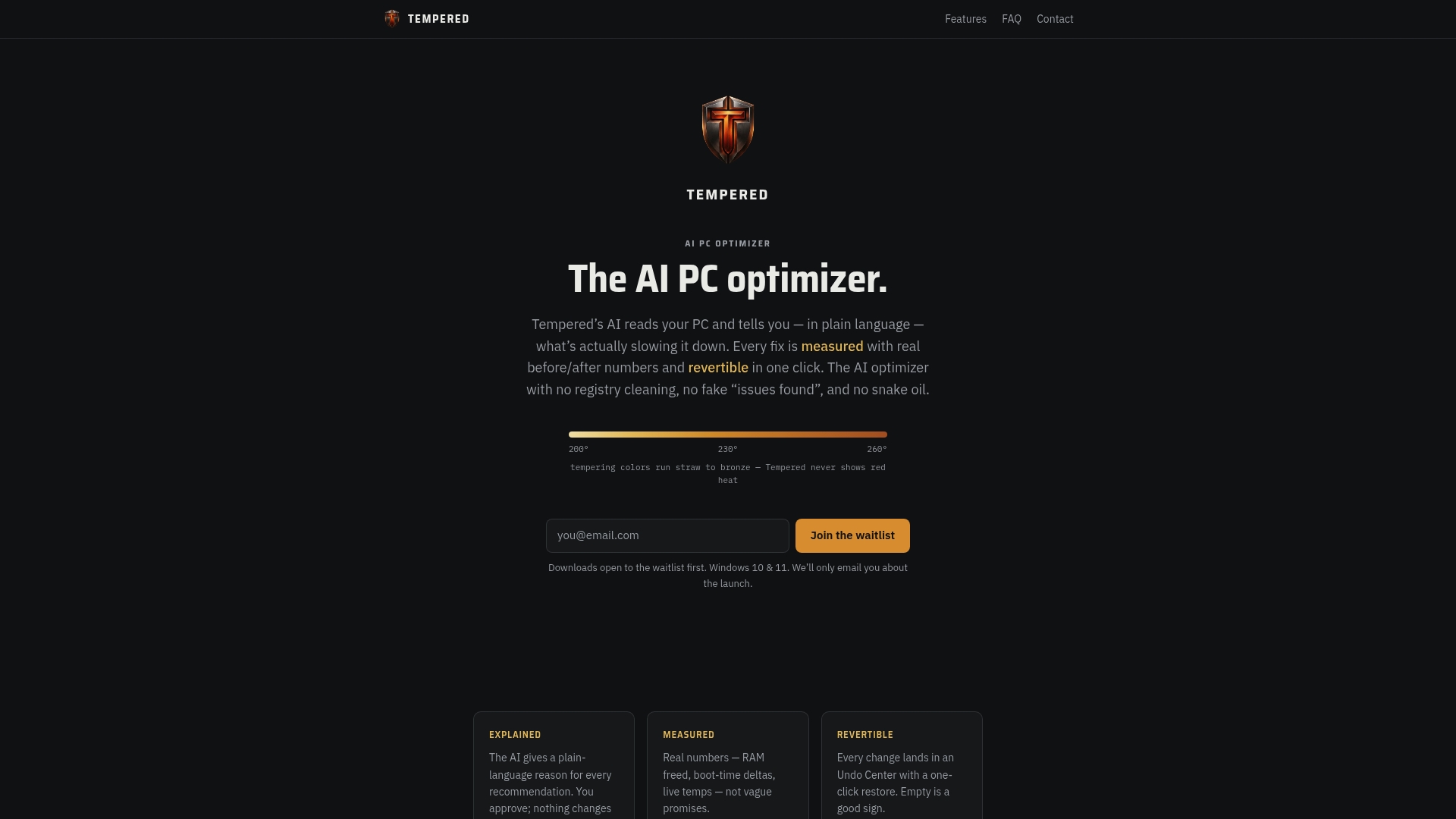
Unlike generic optimizers that make changes without explaining them, Tempered shows you exactly what it found, what it recommends, and why — and every change comes with a one-click undo. There's a free tier with limited AI scans if you want to see what it surfaces on your system before committing to anything. Visit Tempered to run a free diagnostic scan and find out what's actually causing your display issues.
Sources
The resources below back the steps in this guide and are worth bookmarking for deeper reference:
- Restarting the video driver to solve black screen issues | Dell US
- Keyboard shortcuts in Windows - Microsoft Support
- How to Restart the Graphics Driver in Windows 11 | NinjaOne
- NVIDIA Driver Help|NVIDIA UK
- How to reset graphics driver | TechRadar
For IT admins troubleshooting graphics issues as part of a wider systems problem, Netverge's network troubleshooting guide covers the systematic diagnostic methodology that applies equally well to driver and display issues in managed environments.